
Salento Travel Guide: What to See, Do and Ride (2026)
By Eugenio TommasiUpdated 15 August 2026 11 min read
Key facts
- Nearest airport
- Brindisi (BDS), 46 km / about 40 min from Lecce by road
- Getting around
- Rental bike or car — local trains run infrequently between towns
- Best base
- Lecce (central) or a coastal town (Otranto, Gallipoli) for a beach-first trip
- Minimum trip length
- 3-4 days for the coast; 5-7 days to add Valle d'Itria
- Best months
- April, May and October for mild weather; June and September are warm shoulder months
Getting to Salento
Brindisi Airport (BDS) is Salento's real gateway — closer and better connected for most international routes than Bari, which sits over an hour further north. The airport authority publishes no direct bus to Lecce, and Lecce is not part of the Pugliairbus network it operates, so don't plan around one. What is officially published is the STP shuttle between the airport and Brindisi's Stazione FS: every 30 minutes from 05:00 to 00:15, 10-15 minutes, €1.10. From there you take a Trenitalia service on to Lecce — we haven't been able to confirm an official journey time or frequency for that leg, so check current timetables before you travel. Driving straight from the airport to Lecce is 46 km, about 40 minutes. Unless your accommodation is walking distance from a train station, a taxi, transfer or rental car direct from the airport is simpler than the two-leg option.
Bari Airport (BRI) is the other option, mainly if you're combining Salento with Valle d'Itria or Bari itself — allow around 1 hour 50 minutes to drive from Bari to Lecce.
Riding this route on one of our bikes? Start from our rent a bike in Puglia — delivery, sizes and prices are all there.
Getting around Salento
Salento is flat and compact, which makes it genuinely practical to get around without a car — but the region's public transport wasn't built with that in mind. The Ferrovie del Sud Est (FSE) network reaches most of the peninsula, with lines from Lecce to Gallipoli, from Maglie to Otranto, and from Zollino and Novoli down to Gagliano del Capo, the railhead for Santa Maria di Leuca. Service is thin, though: Otranto sits on the Maglie branch, so most journeys from Lecce need a change at Maglie or Zollino, and on Sundays and public holidays FSE replaces the trains with buses on the same routes. That works if your whole trip is timed around it; it doesn't work for spontaneous day trips — check the official FSE site for the day you're travelling.
This is exactly the gap a rental bike fills. Distances between Salento's main towns are short and flat — Lecce to Otranto is 47 km, Lecce to Gallipoli 39 km — genuinely rideable in a morning, and far more flexible than working around a once-daily train. See our bike rental in Lecce & Salento for delivery to your accommodation.
STP Brindisi and other local operators run buses between the bigger towns, generally more frequent than the trains but with the same weekend and off-season reductions — check the current timetable a day or two ahead rather than assuming a summer schedule holds year-round. A rental car is the most flexible option for reaching countryside masserie away from the towns, but is genuinely unnecessary if your trip stays close to the coast.
Where to base yourself
Lecce is the obvious hub: central, well-connected to Brindisi Airport, with the highest concentration of restaurants and Baroque architecture in the region to walk through at the start or end of each day. It's also our base, so it's where free bike delivery applies.
A coastal town — Otranto or Gallipoli are the most practical — makes more sense if your trip is beach-first and you're happy to day-trip inland to Lecce rather than the other way round. Otranto suits the Adriatic side and closer access to Grotta della Poesia and Grotta Zinzulusa; Gallipoli suits the Ionian side and its own old-town beach.
Splitting a longer trip — a few nights in Lecce, then a few on the coast — avoids the trade-off entirely and is the option we'd suggest for anything over 5 days.
What to see in Salento
Salento's essentials are Lecce's Baroque old town, Otranto's Norman-era mosaic cathedral, Gallipoli's island historic centre, and Santa Maria di Leuca at the peninsula's southern tip, where the Adriatic and Ionian seas meet. The two furthest apart, Lecce and Santa Maria di Leuca, are 70 km apart by road, which is what makes a coastal loop between all four realistic in a single trip. For the full detail on each — opening hours, what to look for, how to get there by bike — see our guide to Puglia's best places to visit, which covers all four in depth alongside the rest of the region.
What to do in Salento
Beyond sightseeing, Salento's standout experiences are the Grotta della Poesia, a natural sea-cave pool near Roca Vecchia inside a ticketed archaeological area that has run under a new concession since July 2026 — check the current access rules before planning to swim; the Grotta Zinzulusa, a marine karst cave near Castro reachable on foot or by boat; tasting Primitivo wine at a countryside masseria around Manduria; and, if your dates land in late July or August, the Notte della Taranta, which its organisers describe as the largest concert of traditional popular music in Europe. In 2026 the touring festival opens on 30 July at Corigliano d'Otranto and ends with the free Concertone at Melpignano on Saturday 22 August. Full details, prices and durations for all of these are in our things to do in Puglia guide.
What to ride in Salento
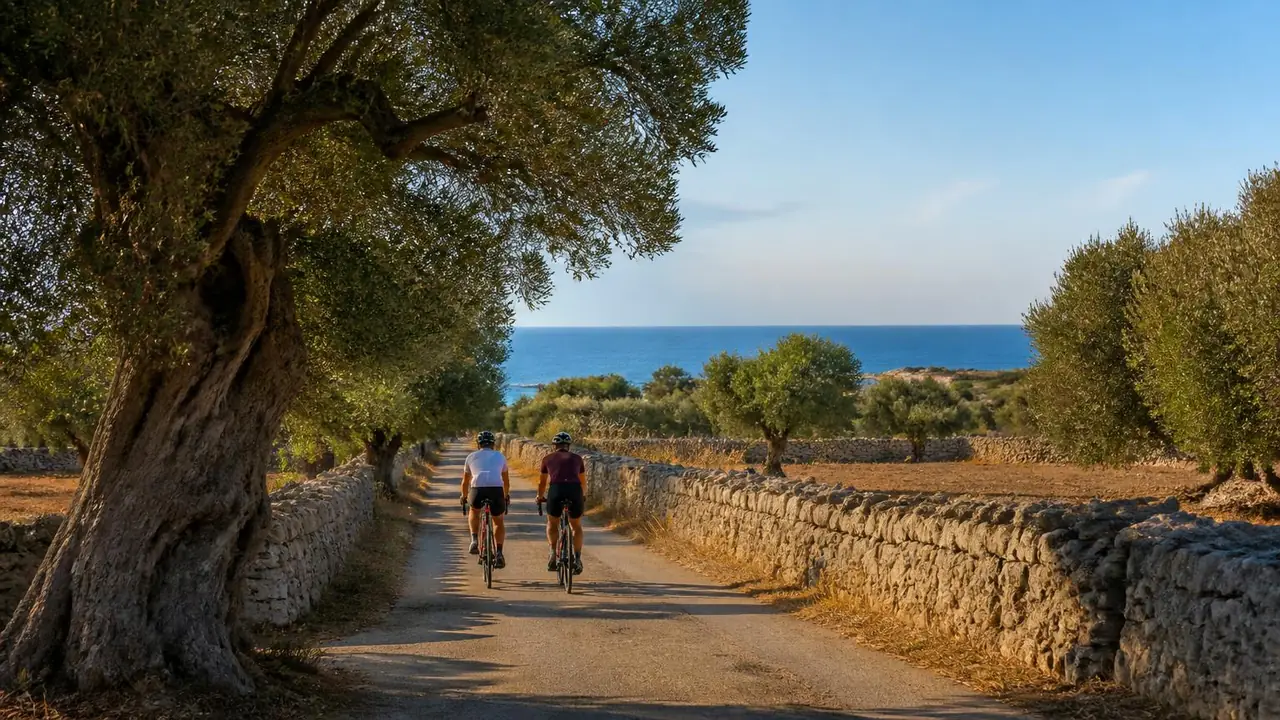
Salento is the flattest, most beginner-friendly riding in Puglia, and the region rewards covering it by bike more than almost anywhere else in Italy: near-zero traffic on secondary roads, shade from olive groves, and short, flat distances between towns worth visiting. Two ways to structure a ride here — one you can do today, one still being built:
- Day loops from Lecce: out to San Foca or Otranto and back, or a Lecce-Gallipoli-Nardò triangle — all comfortably doable in a half-day at a relaxed pace.
- The Ciclovia dell'Acquedotto Pugliese: this greenway follows the main channel of the Puglia aqueduct and is planned to run roughly 500 km from Caposele, in Campania, to Santa Maria di Leuca. Only the northern sections are open. The 157 km southern leg from Grottaglie down to Leuca was still at the design stage in the Regione Puglia's last official update, so there is no continuous Salento stretch to ride yet — check for current progress before planning a trip around it.
Water refill points are limited between towns, so carry two bottles from April onward. As a benchmark, one short route we've ridden near Lecce — Torre Specchia to San Cataldo to Frigole — runs 22.5 km with only about 15 m of elevation gain, essentially flat start to finish. See our full cycling in Puglia guide for routes across the rest of the region, or guided tours in Salento & Lecce if you'd rather ride with a local guide who knows the roads.
Salento itineraries by trip length
| Length | Suggested plan |
|---|---|
| 3 days | Lecce (1 day) + Otranto day trip + Gallipoli or a beach day |
| 5 days | Lecce (2 days) + Otranto (1 night) + Santa Maria di Leuca loop + Gallipoli |
| 7 days | The 5-day plan above, plus 2 days added in Valle d'Itria (Ostuni, Alberobello — see best places to visit in Puglia for the towns beyond Salento) |
For any of these, the coastal towns are close enough together that a rental bike can realistically replace a car for the Salento portion — a rarity in Italy.
A day-by-day breakdown of the 5-day plan:
- Lecce — old town, Basilica di Santa Croce, evening in the Baroque centre.
- Lecce — Grotta della Poesia at Roca Vecchia in the morning, a wine tasting or masseria lunch in the afternoon.
- Otranto — ride or drive up, cathedral and old town, overnight on the coast.
- Santa Maria di Leuca loop — via Otranto's coastline south to the tip of the peninsula.
- Gallipoli — old town, castle, and an Ionian-coast beach afternoon before heading back to Lecce or the airport.
Practical tips
A few things that catch first-time visitors out: many shops and some restaurants close for a few hours in the early afternoon outside the main tourist strips, so plan sightseeing around that rather than around it. Tap water is safe to drink throughout Salento. Cash is still useful in smaller villages and at some countryside masserie, even though card payment is now widely accepted in towns. And pack for sun, not just heat — Salento's coastline has very little natural shade once you're away from the old towns' narrow streets.
Best time to visit
April, May and October are the mildest months, with average daily highs of 19-25°C in Lecce and manageable crowds. June and September are warm rather than mild — 29.5°C and 27.7°C on average — so they still work for riding if you start early. July-August averages above 32°C, and Lecce and the coast get genuinely busy, especially around the Notte della Taranta in late August. November-March is quiet and mild by Northern European standards, though wind and rain are less predictable, and some seasonal attractions reduce their hours. Temperature figures are mean daily maximums for Lecce from ISPRA's 1981-2010 climate normals; the coastal strip runs a couple of degrees cooler than the inland station.
FAQ
How do I get from Brindisi Airport to Lecce? There's no direct train, and the airport publishes no direct bus to Lecce. Take the STP shuttle to Brindisi's Stazione FS (every 30 minutes, 10-15 minutes, €1.10) and a Trenitalia train on from there, or drive: 46 km, about 40 minutes.
Do I need a car in Salento? Not necessarily — distances between the main towns are short and flat, and a rental bike covers day trips that the limited local train network doesn't serve well. A car helps mainly for reaching countryside masserie for wine tasting.
How many days do I need in Salento? 3-4 days covers the coastal essentials (Lecce, Otranto, Gallipoli); 5-7 days allows a more relaxed pace with Santa Maria di Leuca added; 7+ days lets you extend into Valle d'Itria.
Is Salento better than the rest of Puglia? It's different rather than better — flatter and more beach-focused than Valle d'Itria's hill towns or Gargano's cliffs. Most longer trips combine Salento with at least one other area.
Should I base myself in Lecce or on the coast? Lecce if you want a central, well-connected base with the widest choice of restaurants; a coastal town like Otranto or Gallipoli if your trip is beach-first. Splitting a longer trip between both avoids the trade-off.
What's the best time of year to visit Salento? April, May and October are the mildest, with average daily highs of 19-25°C in Lecce. June and September are warm shoulder months rather than mild ones; July-August averages above 32°C and is the busiest stretch, especially around the Notte della Taranta festival in late August.
Plan your Salento trip : tell us your dates and how many days you have, and we'll match you to the right bike rental or guided tour to cover the region.