
What to See and Do in Trani, Puglia's Cathedral Town on the Sea
By Eugenio TommasiUpdated 19 August 2026 7 min read
Key facts
- Best for
- A Romanesque cathedral built on the water, a 13th-century castle, a working fishing port and one of Puglia's few active synagogues
- Time needed
- Half a day for the cathedral, castle, port and old Giudecca quarter; a full day with the ride to Bisceglie
- Getting around
- On foot in the old town — flat throughout, everything within a few minutes' walk; bike for the coast north or south
- Indicative cost
- Old town, port and Villa Comunale are free to walk; Castello Svevo €8 full, €2 reduced (18-25), free under 18, per the Ministero della Cultura; the cathedral's official site lists no admission price, so check current pricing when you visit
- Distance from Bari
- 47 km (29 miles) on the coastal SS16, about 50 minutes by car — 56 km (35 miles) and about 45 minutes on the A14 motorway; direct regional trains take about 40 minutes
- Distance from Lecce
- 203.5 km (126 miles), about 2h35 by car; by train with a change at Bari Centrale
- When to go
- April-June and September-October for mild weather; the cathedral keeps longer hours from April to October (see below)
Trani's old town: a cathedral on the water
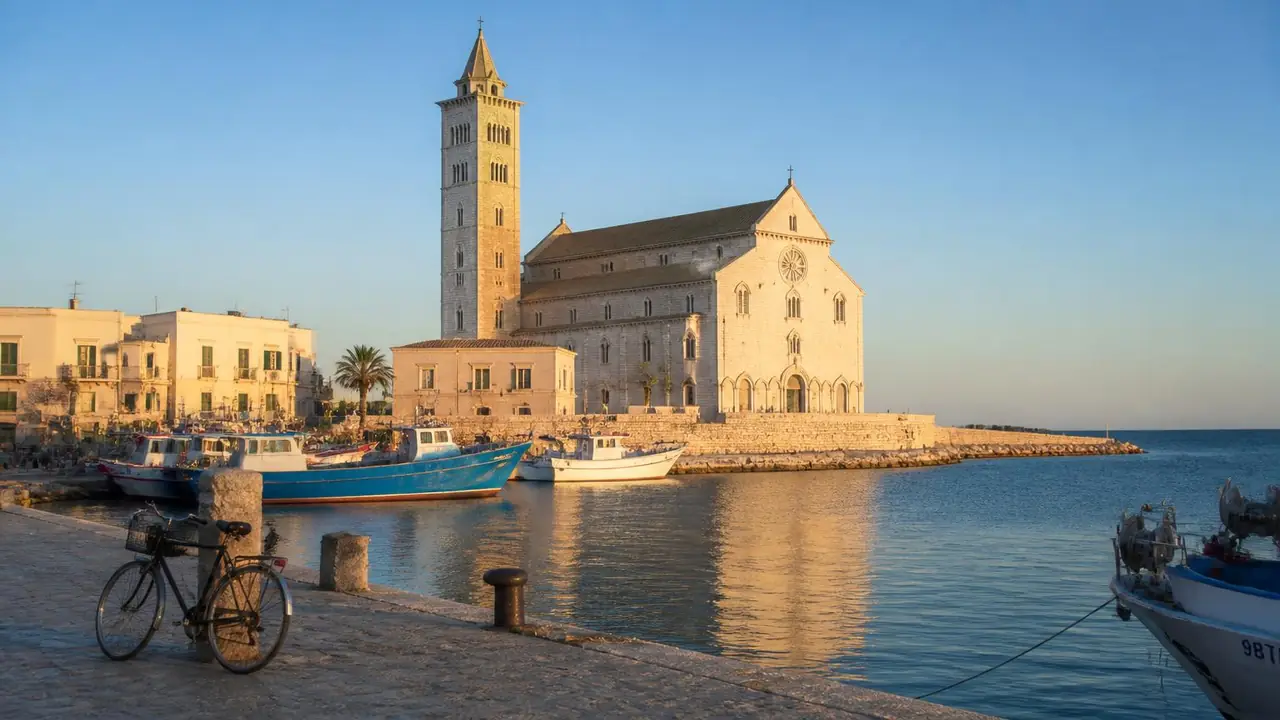
Trani sits on Puglia's Adriatic coast, about 47 km up the coast from Bari and roughly 200 km from Lecce — well outside the area we cover regularly from our Salento base. Its landmarks sit tightly on the waterfront: the cathedral, the castle and the fishing port within a few hundred metres of each other, with the old Giudecca, Trani's historic Jewish quarter, just inland.
Trani is flat, built at low elevation just a few metres above sea level, so the old town is straightforward on foot and a coastal bike ride stays level rather than opening with a climb. Four medieval synagogues once stood here, all turned into churches at the end of the 13th century, according to the Fondazione per i Beni Culturali Ebraici in Italia. Two survive: the Scolanova, back in Jewish use since 2005, and the Scolagrande, now the Museo di Storia Ebraica di Scola Grande in the former church of Sant'Anna — a detail that sets Trani apart from most other stops on this coast.
Riding this route on one of our bikes? Start from our bike rental in Puglia — delivery, sizes and prices are all there.
Trani's sights, one by one
Cattedrale di San Nicola Pellegrino
What it is
a Romanesque cathedral built between 1097 and 1197 in pale local limestone, with roots going back to the paleochristian era, per the cathedral's own official site. Its crypt is dedicated to San Nicola Pellegrino; a lower crypt, Santa Maria della Scala, holds mosaics dated to the 5th-6th century.
Why it's worth it
it stands directly on the Adriatic, sea on three sides, no promenade between church and water — a setting unlike the harbour towns further south. Its bronze door is by the local sculptor Barisano da Trani, dated by the Catalogo generale dei Beni Culturali to between 1175 and 1180 and made up of 32 panels of sacred and secular scenes. What hangs in the portal today is a faithful copy, installed in 2012: the restored original is displayed inside the cathedral, so look for it indoors rather than assuming you have already seen it on the way in.
Practical
hours per the official site — April-October, weekdays 09:00-12:30 and 15:30-19:00, holidays 09:00-12:30 and 16:00-20:00; November-March, weekdays 09:00-12:30 and 15:30-18:00, holidays 09:00-12:30 and 16:00-19:30. Visits pause during services. No admission price is listed on the official site, so check current pricing when you visit. Address: Piazza Duomo, Trani. Opening hours change seasonally — check the official site before you go.
Getting there
on foot, at the centre of the old town, a couple of minutes from the port or the castle.
- First-hand tip: services can close the nave to visitors with little notice — the official site is the clearest source we found on this.
Castello Svevo
What it is
a fortress built for Frederick II of Swabia on the model of Crusader castles, per the official Ministero della Cultura site — the oldest inscription dates to 1233. Quadrangular plan, four corner towers, later adapted for firearms defence and used as a prison through the 19th century before its 1970s transfer to the Ministry of Culture.
Why it's worth it
the ground floor houses a museum of stone finds and ceramics from local excavations — part of the same defensive network as Castel del Monte, further inland.
Practical
per the Ministero della Cultura's own listing, Monday to Saturday 08:30-19:30 and Sunday 08:30-13:30, with weekday public holidays on the shorter Sunday hours; last admission one hour before closing. Full ticket €8, reduced €2 for 18-25s, free under 18. Address: Piazza Manfredi 16, Trani. Phone: +39 0883 506603. Opening hours change seasonally — check the official site before you go.
Getting there
on foot, on the waterfront a short walk from the cathedral.
- First-hand tip: the Sunday closing at 13:30 catches people out — if Sunday is your only day in Trani, do the castle first and the cathedral after lunch.
Sinagoga Scolanova
What it is
a Gothic synagogue in the old Giudecca quarter, at Via Scolanova 23. It was one of four synagogues in medieval Trani, all turned into churches at the end of the 13th century — hence its other name, Santa Maria in Scolanova. It was returned to synagogue use in 2005.
Why it's worth it
it is used for worship today, under the Jewish Community of Naples and its Trani section — the working synagogue of a town that also keeps the only Jewish history museum in southern Italy, in the former Scolagrande a few streets away.
Practical
it is a place of worship, not a museum. The Fondazione per i Beni Culturali Ebraici in Italia says it opens for certain dates in the Jewish calendar, when the local community gathers; there is no published daily timetable or admission fee. Opening dates can change from year to year, so contact the Jewish Community of Naples before you go if you want to see inside.
Getting there
on foot, in the old Giudecca quarter, a short walk from the cathedral.
- First-hand tip: it's a synagogue in active use, not a monument — visit it as you would any working place of worship.
Il porto peschereccio (fishing port)
What it is
Trani's harbour, a natural inlet formed at the mouth of a river that no longer exists, sitting directly below the cathedral and the castle.
Why it's worth it
a working fishing port, not a marina — boats moor beneath walls that have sheltered them for centuries, and the restaurants along the quay work from what comes in that morning.
Practical
open public space, free, accessible at any time.
Getting there
on foot, between the cathedral and the castle.
- First-hand tip: the view back toward the cathedral from the harbour wall, church rising straight out of the water, is the best vantage point in Trani.
Seeing Trani by bike
Trani sits at low elevation right on the coast, so a ride out of town in either direction starts flat and stays that way — there's no climb at either end to plan around.
Route: Trani to Bisceglie
South along the coast, Bisceglie is 11.8 km (7.3 miles) one way by road — about 24 km (15 miles) round trip. We haven't ridden this stretch ourselves, since Trani sits well outside the area we cover from our Lecce base, so treat the surface and elevation profile as a planning estimate rather than a route we've checked in person. What we can confirm: both towns sit only a few metres above sea level on the same stretch of coast, connected by a direct train that Trenitalia's own timetable puts at about six minutes, if the ride doesn't suit the return leg. Fill water bottles before setting off — the Villa Comunale, on its small peninsula north of the old town, is the last easy stop before the open coast road. For the wider trip, our day trips from Bari guide covers how Trani fits alongside Polignano a Mare and Monopoli further south, and which of those work by bike.
Rent the right bike for the coast through our bike rental in Puglia — road or gravel handles a paved coast road fine, an e-bike takes the effort out of the return leg. Trani sits outside our free-delivery zone of Lecce, San Foca and Calimera, but tell us your dates and we'll quote delivery from our base at Via Francesco Ribezzo 2D, Lecce. See our cycling in Puglia guide for the wider regional picture.
How much time do you need in Trani?
| Time available | What you can realistically cover |
|---|---|
| 2-3 hours | Cattedrale di San Nicola Pellegrino, the Castello Svevo from outside, and a walk along the port |
| Half a day | The above, plus the Sinagoga Scolanova in the old Giudecca quarter and the Villa Comunale |
| Full day | The old town on foot, plus a bike ride along the coast toward Bisceglie |
Trani sits naturally alongside Bari, Polignano a Mare and Monopoli as a cluster of Adriatic coast towns linked by regional train — see the best places to visit in Puglia for how it fits into a longer trip, or things to do in Bari if you're basing yourself there instead.
Getting to Trani
Trani has its own station on the Adriatic line between Bari and Foggia. Direct regional trains run to and from Bari Centrale: a stopping service in Trenitalia's own published timetable leaves Bari Centrale at 06:29 and reaches Trani at 07:07, calling at Bisceglie six minutes earlier — so about 40 minutes from Bari, and about six minutes from Bisceglie.
| From | Distance (road) | By car | By train |
|---|---|---|---|
| Bari | 47 km (29 miles) on the SS16; 56 km (35 miles) via the A14 | about 50 minutes on the SS16, about 45 on the A14 | direct, about 40 minutes |
| Lecce (our base) | 203.5 km (126 miles) | about 2h35 | change at Bari Centrale |
| Bisceglie | 11.8 km (7.3 miles) | about 16 minutes | direct, about 6 minutes |
Road distances measured on OpenStreetMap routing (OSRM), August 2026, from Bari Centrale and from Piazza Sant'Oronzo in Lecce to Piazza Duomo in Trani. Train times move with the timetable, so check current departures on Trenitalia's official site before travelling rather than planning around the figures above. Trenitalia has engineering work on the Foggia-Bari Centrale line affecting one regional service on Fridays from 14 August to 4 September 2026.
FAQ
What is Trani best known for? The Cattedrale di San Nicola Pellegrino, a Romanesque cathedral built directly on the Adriatic with the sea on three sides. The 13th-century Castello Svevo, the working fishing port and the Sinagoga Scolanova, still used for worship, round out its main landmarks — all within a few minutes' walk of each other.
How do I get from Bari to Trani without a car? Direct regional trains connect Bari Centrale to Trani on the Adriatic line in about 40 minutes: Trenitalia's own timetable shows a 06:29 departure from Bari Centrale arriving at 07:07. Times vary by service, so check current departures on Trenitalia's site. By road it's 47 km (29 miles) on the coastal SS16, about 50 minutes.
Is the Cattedrale di San Nicola Pellegrino free to visit? The cathedral's official site doesn't list an admission price, and tourist visits pause during religious services. Opening hours run longer from April to October than over winter, on both weekdays and holidays. Opening hours change seasonally — check the official site before you go.
Are the bronze doors of Trani cathedral the original ones? No. The door at the portal is a faithful copy installed in 2012; the restored original by Barisano da Trani, dated by the Catalogo generale dei Beni Culturali to between 1175 and 1180, is displayed inside the cathedral. It has 32 bronze panels of sacred and secular scenes.
Can I visit Trani as a day trip from Lecce? It's possible but long — Trani is 203.5 km (126 miles) from Lecce, about 2h35 by car, or by train with a change at Bari. It's a far more realistic day trip from Bari, 47 km away.
Is Trani's Sinagoga Scolanova open to visitors? It's a place of worship rather than a museum, returned to synagogue use in 2005 after centuries as a church. The Fondazione per i Beni Culturali Ebraici in Italia says it opens for certain dates in the Jewish calendar rather than to a daily timetable, so contact the Jewish Community of Naples, which looks after it, before you go. For Jewish Trani on fixed hours, the Museo di Storia Ebraica di Scola Grande occupies the former church of Sant'Anna nearby.
What's the best time of year to visit Trani? April-June and September-October give the mildest weather with fewer crowds. The cathedral keeps longer hours from April to October than over winter; July-August is warmer and noticeably busier along the port, the waterfront and the old town's restaurants and bars.
Plan your Puglia trip — bike rental with delivery. If Trani is part of a longer route along the Adriatic coast, rent the right bike for it — road, gravel or e-bike, matched to how far you're riding. We're based at Via Francesco Ribezzo 2D, Lecce — open 24/7, phone +39 320 4864478 — and while Trani sits outside our free-delivery zone of Lecce, San Foca and Calimera, we quote delivery here for any address once we know your dates.