
Unique Experiences in Puglia: Unusual Things to Do
By Eugenio TommasiUpdated 19 August 2026 8 min read
Key facts
- Experience
- When
- A night in a trullo
- Year-round; best April-June and September-October
- Olive harvest at a masseria
- Mostly late October to December; Olio di Puglia IGP rules allow picking until 31 January
- Massafra's rock-cut churches
- Sanctuary open Tue-Sun 10:00-13:00 and 15:30-18:30, closed Mondays (Comune di Massafra)
- Dry stone walls (muretti a secco)
- Year-round, always visible
- Festa di Santa Domenica, Scorrano (luminarie)
- Traditionally 5-8 July; the Comune lists 5-8 July for the 2025 edition — confirm exact 2026 dates locally before you travel
A night in a trullo
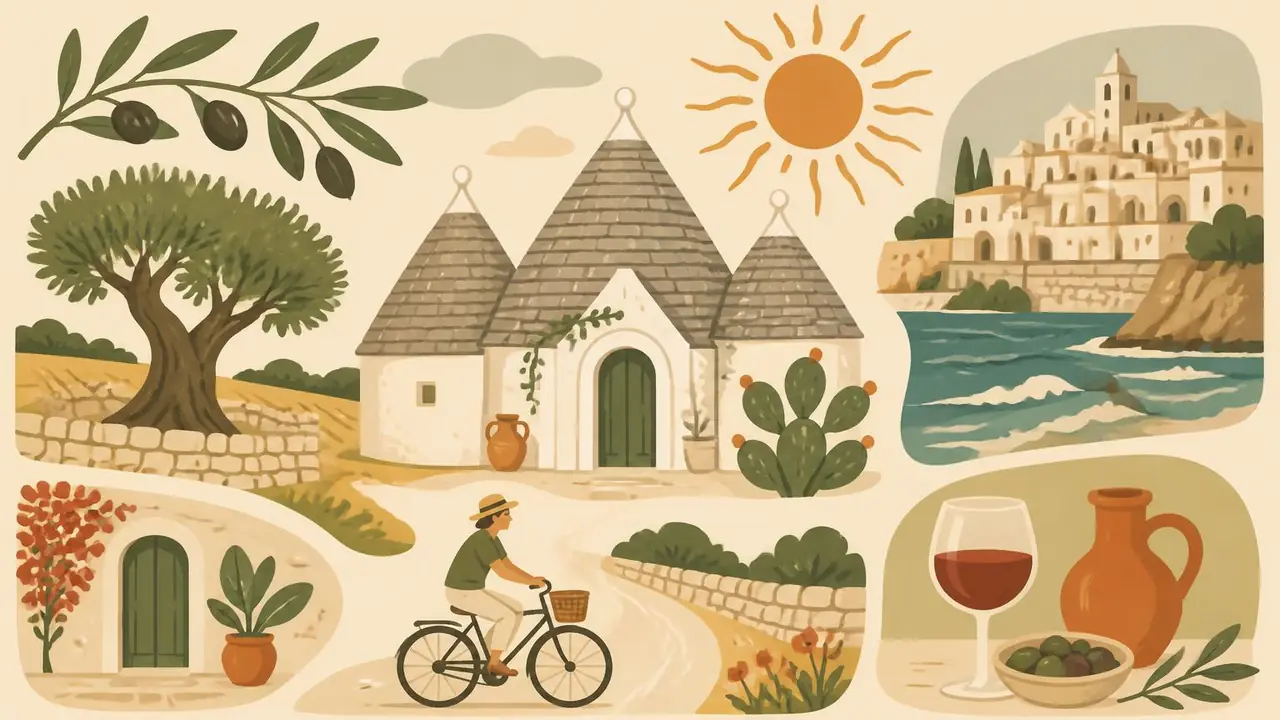
A trullo is a whitewashed, conical-roofed stone house built without mortar — dry stone construction, the same technique behind the countryside walls described further down this page. Alberobello's Rione Monti and Aja Piccola districts, where over 1,500 trulli survive, have been UNESCO World Heritage-listed since 1996, under criteria (iii), (iv) and (v). Most visitors walk through for an afternoon and leave.
Why it's different: staying overnight, rather than passing through, means being inside the thick stone walls after the day-trip coaches have gone — a working trullo interior is small, cool even in August, and built around the single conical chimney at its centre.
Where and when: trulli are concentrated across Valle d'Itria — Alberobello, Locorotondo, Cisternino and Martina Franca — a region around 110 km (68 miles) from Lecce, about 1 hour 20 minutes by car. Many have been restored as self-catering cottages or masseria rooms, available year-round.
How to book: direct with a trullo rental or masseria — there's no single operator to point to, and prices vary by season and property, so check current pricing when you book. For what to see in town before or after your stay, see our guide to Alberobello.
Riding this route on one of our bikes? Start from our bike rental in Puglia — delivery, sizes and prices are all there.
Join a working olive harvest
Puglia is Italy's largest olive oil region, and the harvest — la raccolta — falls mostly between late October and December, depending on the year and the variety. The Olio di Puglia IGP production rules allow picking from véraison until 31 January, so the season can run well past Christmas. Some working masserie and agriturismi across Salento and Valle d'Itria let visitors join for a morning: nets under the trees, olives combed or shaken down by hand, then taken to the frantoio (press) — the same IGP rules require milling within 36 hours of picking.
Why it's different: it's agricultural work, not a tasting — you leave with stained hands and, at some properties, a bottle of the oil pressed that day rather than a souvenir.
Practical
this isn't something we run or book ourselves — contact an agriturismo or masseria in the harvest window and ask whether they take visitors that season, since not all do and capacity is limited, and costs vary by property, so check current pricing when you ask. For the wine side of the same countryside, see our wine tasting guide — vineyards and olive groves in Salento often sit side by side.
Descend into Massafra's rock-cut churches
Massafra, a town of just under 32,000 people bordering Taranto directly, sits on the edge of a network of gravine — steep limestone ravines cut into the Murgia plateau. Inside them are chiese rupestri, churches carved straight into the rock rather than built on top of it, some with Byzantine-era frescoes still visible on the walls.
Why it's different: underground, rock-cut heritage, not a Baroque church or a castle — the kind of site that barely features on standard Puglia itineraries built around the coast and the trulli towns.
What to see: the Santuario della Madonna della Scala, reached down a baroque staircase of 127 steps into the Gravina della Madonna della Scala; the Gravina di San Marco, with its own cluster of rock settlements; and the Cripta di San Leonardo, an underground church holding a fresco of Saints Cosma and Damiano. The Comune counts around thirty rupestrian churches across its territory.
Access: this is not a walk-up site. The Comune di Massafra lists the sanctuary as open Tuesday to Sunday, 10:00-13:00 and 15:30-18:30, closed Mondays, with booking required two days in advance and tours departing from the info point in Piazza Garibaldi. For the rock-cut churches the Comune states a municipal ticket of €5 per person for groups of one to ten, plus a separate guide fee that varies. Opening hours and fees change seasonally — check the official site before you go.
Getting there
Massafra sits right next to Taranto, which is 108 km (67 miles) from Lecce, about 1h30 by car; the final stretch on to Massafra itself is short, but treat it as a planning estimate rather than a distance we've measured ourselves. See our guide to Taranto for the city itself, and best places to visit in Puglia for a wider trip.
Spot Puglia's UNESCO-listed dry stone walls
The low, mortarless stone walls running along nearly every country lane in central Puglia and Salento are not incidental scenery. The technique behind them — stacking and interlocking stone with no mortar at all — was inscribed on UNESCO's Representative List of the Intangible Cultural Heritage of Humanity in 2018 as "Art of dry stone walling, knowledge and techniques", nominated by Italy alongside seven other countries: Croatia, Cyprus, France, Greece, Slovenia, Spain and Switzerland. In 2024 UNESCO extended the same element and re-inscribed it under the wider title "Art of dry stone construction, knowledge and techniques", which now covers thirteen countries.
Why it's different: most visitors drive or ride past thousands of these walls without knowing they're looking at a globally recognised craft, built and repaired the same way for generations, used here purely as field boundaries. On the Murgia plateau further north, the same technique built jazzi — rough shelters used during centuries of seasonal sheep transhumance.
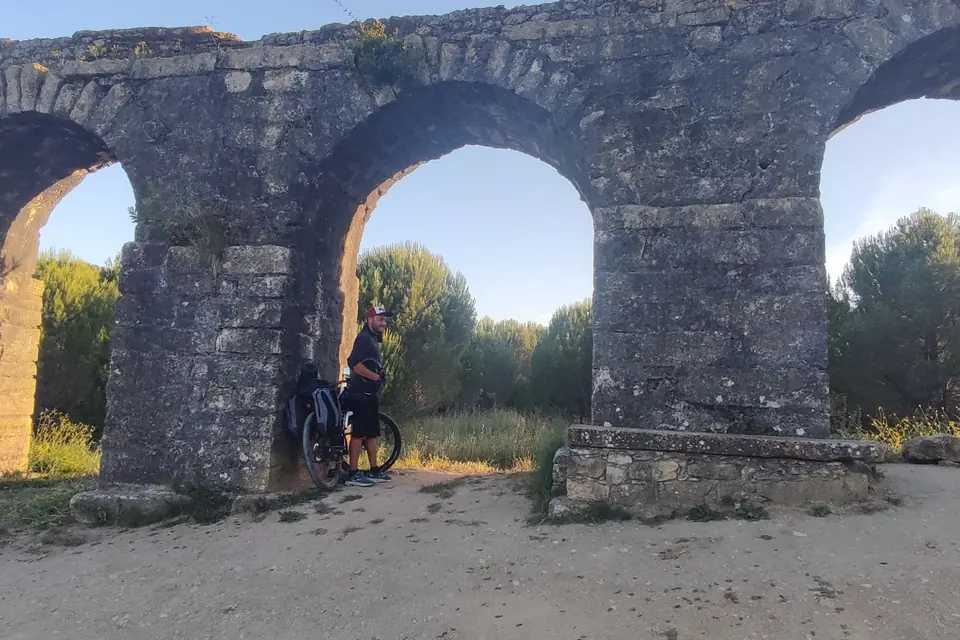
How to experience it: there's no ticket or workshop we can point you to — the honest version of this experience is slowing down on a country road, getting off the bike, and looking closely at how the stones interlock without any binding material. It's free, it's everywhere in Salento's countryside, and it's easiest to actually notice from a bike rather than a car.
Catch a village feast lit up with luminarie
Luminarie are freestanding arches and towers of small lights, built new each year by local craftsmen and strung above the streets for a town's festa patronale — its patron saint's feast. In Scorrano, inland Salento, the Festa di Santa Domenica traditionally runs from 5 to 8 July, the dates the Comune di Scorrano listed for the 2025 edition. The Comune had not published the 2026 dates when we checked, and the listings that circulate elsewhere disagree with each other — check the Comune's own event page before you plan a trip around it.
Why it's different: this isn't Notte della Taranta or Carnevale di Putignano — it's a small, hyperlocal event, the kind that happens in dozens of Salento towns each summer without ever reaching an international tourist itinerary, built entirely around one town's own saint rather than a festival calendar.
Practical
free, open-air, no ticket — turn up in the evening when the luminarie are lit. Exact dates shift slightly year to year, so check locally rather than relying on a fixed calendar; the same applies to smaller patron saint feasts in other Salento villages through the summer. For more on planning a Salento trip around events like this, see our day trips from Lecce guide.
Experiencing Puglia by bike
Several of the experiences above change depending on how you get to them. A masseria hosting an olive harvest morning is a different arrival by bike than by car: you roll in on the same quiet lane the pickers use, past the same dry stone walls, rather than parking in a gravel yard. We've mapped a real example of this kind of countryside elsewhere on the site — the 28 km (17 mile) run from Lecce out to Salice Salentino, through vineyard and olive-grove lanes lined with the same mortarless stone walls described above, covered in our wine tasting guide.
Speed is the real difference. A car passes a kilometre of dry stone wall in under a minute; a bike takes several, long enough to see how the stones interlock, or to notice a jazzo (transhumance shelter) against a field boundary that a car would blur past. Salento's flat, quiet lanes are built for this kind of slow noticing — long sight-lines, almost no traffic outside town centres, shade from olive trees for long stretches.
Not every experience above is realistic by bike from our Lecce base. Massafra and the Valle d'Itria's trulli towns are a drive, with cycling once you're there; a village feast like Scorrano's is close enough in inland Salento to combine with a day's ride if the dates line up.
Ride the roads tourists miss — book a guided tour. Tell us which of these experiences you want to build a day around, and we'll tell you honestly what's realistic on two wheels and what needs a car first. For the wider picture of where and when to ride across the region, see cycling in Puglia.
FAQ
What are the most unusual things to do in Puglia? Beyond the usual sightseeing: sleeping in a trullo rather than just visiting one, joining an olive harvest at a working masseria, descending into Massafra's rock-cut Byzantine churches, and catching a small town's own patron saint feast, like Scorrano's luminarie-lit Festa di Santa Domenica.
Can I visit a masseria during the olive harvest? Some do, mostly October to December — Olio di Puglia IGP rules allow picking as late as 31 January — but not all take visitors and capacity is limited, so contact one directly in season and ask. It's agricultural work, not a scheduled tourist activity, so treat any visit as their call.
Is staying in a trullo worth it, or is visiting enough? Depends what you want. A daytime visit to Alberobello covers the sightseeing — the Trullo Sovrano, the Rione Monti district. An overnight stay is a different, quieter experience of the same UNESCO-listed dry stone architecture, once the day-trip groups have left.
Are Massafra's rock-cut churches worth the detour? Yes, if underground and Byzantine-era heritage interests you more than Baroque churches or castles — the Santuario della Madonna della Scala and the Cripta di San Leonardo's fresco are the standout sites, and Massafra sits right next to Taranto.
What are luminarie, and can tourists attend a festa patronale? Luminarie are elaborate arches of lights built fresh each year for a town's patron saint feast. Yes — these are open, free, public street festivals; Scorrano's Festa di Santa Domenica, traditionally 5-8 July, is one example among many across Salento each summer.
Can any of these experiences be combined with cycling? Partly. A masseria or a village feast in inland Salento is realistic to reach by bike from our Lecce base; Massafra and the Valle d'Itria's trulli towns are far enough that we treat them as a drive, with cycling once you're there. See Experiencing Puglia by bike.
Ride the roads tourists miss — book a guided tour. Tell us which of these experiences interests you and your dates, and we'll tell you honestly what works on two wheels and what needs a car connection first. We're based at Via Francesco Ribezzo 2D, Lecce — open 24/7, phone +39 320 4864478.