
What to Do in Alberobello: Trulli, Key Sights and How to Get Around
By Eugenio TommasiUpdated 17 August 2026 9 min read
Key facts
- Best time to visit
- April-June or September-October — mild weather, fewer coach groups than midsummer
- Time needed
- Half a day (3-4 hours) for the historic centre; add a day if riding the Locorotondo-Martina Franca loop
- How to get around
- On foot in the centre — Rione Monti and Aia Piccola sit within 800 m of each other; by bike or car to reach neighbouring towns
- Indicative cost
- Historic centre and both trulli districts are free to walk; Trullo Sovrano entry is €2.50
- Distance from Lecce
- Around 110 km (68 miles), about 1 hour 20 minutes by car; no direct train
Why the trulli look this way
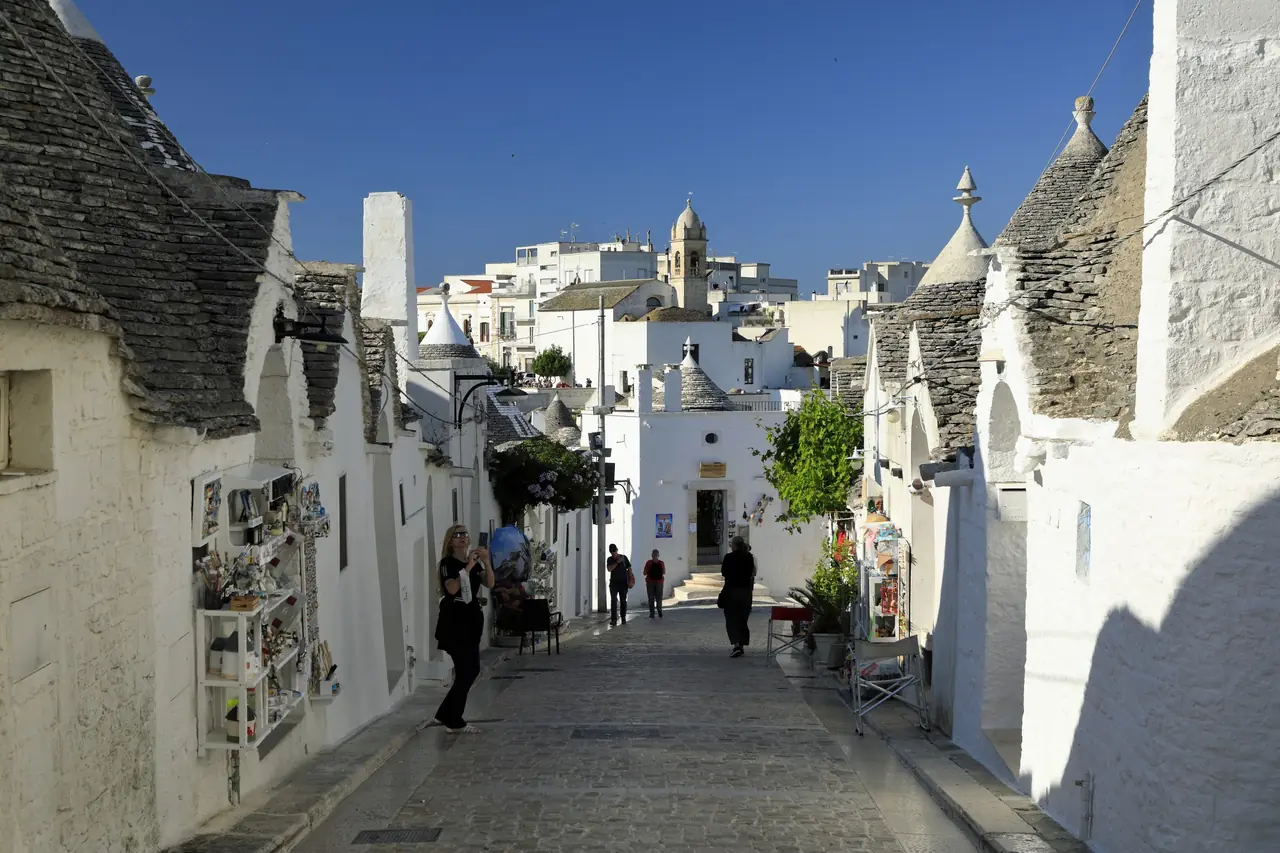
A trullo (plural: trulli) is a small limestone building with a conical roof, built without mortar: the walls and roof are stacked from roughly worked limestone boulders and corbelled slabs, held in place by their own weight rather than any binding agent. This dry-stone technique — the same one used across Valle d'Itria's field walls — is what UNESCO cites as the reason Alberobello was added to the World Heritage List in 1996, recognising the town as "one of the best preserved and most homogeneous urban areas" built this way in Europe.
The mortarless construction has a practical history behind it, too: under the feudal rule of the Counts of Conversano, permanent stone dwellings were taxed by the Kingdom of Naples, while temporary structures were not. Building without mortar meant a roof could reportedly be dismantled quickly if a royal inspector was due, keeping the buildings classified as provisional. That obligation ended in 1797, a turning point covered in the Casa d'Amore section below.
Alberobello's two protected districts, Rione Monti and Aia Piccola, hold more than 1,500 trulli between them. Most are still used as homes, shops or short-term rentals rather than museum pieces, which is why the streets stay lived-in rather than roped off.
Riding this route on one of our bikes? Start from our rent a bike in Puglia — delivery, sizes and prices are all there.
Rione Monti and Aia Piccola: where to see the trulli
Rione Monti
What it is
The larger of Alberobello's two trulli districts, with roughly 1,030 trulli climbing a hillside on the west side of the town centre, according to the property data filed with UNESCO's nomination dossier.
Why it's worth it
Most of the ground-floor trulli here now hold shops selling local wine, ceramics and food — it's the more commercial of the two districts, and the one nearly every photograph of Alberobello shows.
Practical
Streets are open to walk at any time, free of charge. Steepest in the upper part of the district, closest to Chiesa di Sant'Antonio.
Getting there
On foot, 5 minutes from Piazza del Popolo, the town's main square.
Aia Piccola
What it is
The smaller district, with roughly 590 trulli, separated from Rione Monti by the main road through town (Corso Vittorio Emanuele). Its name comes from an aia, a threshing floor once used for the tithe grain owed to the Counts.
Why it's worth it
Fewer shops than Rione Monti and more inhabited houses — a quieter district to walk without the coach-group traffic of the main tourist strip.
Practical
Free and open at any time; several trulli remain private homes, so treat doorways and washing lines as someone's front garden, not a photo backdrop.
Getting there
On foot, directly across Corso Vittorio Emanuele from Rione Monti — about 3 minutes' walk between the two districts.
Trullo Sovrano
What it is
The only two-storey trullo in Alberobello, built in the mid-18th century for a local priest's family. It's now a house-museum.
Why it's worth it
The upper floor exists because the building predates the 1797 end of the feudal-era construction restrictions described below — most trulli stayed single-storey to remain classifiable as temporary. Inside, period furniture across several rooms shows how a trullo interior was actually laid out and lived in, rather than presenting an empty shell.
Practical
Entry is €2.50. Open 10:00-12:45 and 15:30-18:00 from November to March, and 10:00-12:45 and 15:30-18:30 from April to October, according to the official Trullo Sovrano ticket page (checked 19 August 2026). Note the midday closure — it catches people out. Opening hours change seasonally — check the official site before you go.
Getting there
On foot, in Piazza Sacramento, about 4 minutes from Piazza del Popolo.
Chiesa di Sant'Antonio
What it is
A parish church built in 1927 in the same dry-stone, conical-roofed style as the trulli around it, at the top of Rione Monti. It's built on a Greek-cross plan, with a conical dome over the crossing.
Why it's worth it
It's the clearest example of trullo construction applied to a building far larger than a house — the technique scaled up to a working church rather than kept to domestic use. The interior holds frescoes by the painter Adolfo Rollo.
Practical
An active parish church, not a ticketed monument: the official parish site (checked 19 August 2026) publishes Mass times but no visiting hours for the public. Mass is at 19:00 on weekdays from June to September and 18:00 from October to May, with four Sunday Masses. Opening hours change seasonally — check the official site before you go.
Getting there
On foot, uphill through Rione Monti, about 8 minutes from Piazza del Popolo — it's the highest point in the district.
Casa d'Amore
What it is
A house on Piazza Ferdinando IV di Borbone, built in 1797 by Francesco D'Amore — the first building in Alberobello constructed with mortar rather than dry-stacked stone.
Why it's worth it
The date matters more than the architecture. In 1797, King Ferdinando IV of Naples freed Alberobello from the feudal tribute owed to the Counts of Conversano, ending the obligation that had kept buildings dry-stone and dismantlable. Casa d'Amore went up almost immediately after, with a Latin inscription on its facade — EX AUCTORITATE REGIA HOC PRIMUM ERECTUM A.D. 1797 ("built first by royal authority, in the year 1797") — recording the moment directly.
Practical
Viewable from the outside in Piazza Ferdinando IV di Borbone at any time.
Getting there
On foot, 2 minutes from Piazza del Popolo, at the edge of Rione Monti.
Belvedere Santa Lucia
What it is
A terrace next to the Chiesa di Santa Lucia, on the opposite side of the valley from Rione Monti.
Why it's worth it
It's the wide-angle view of the trulli rooftops that the narrow streets inside Rione Monti can't give you — the whole conical roofline of the district, laid out below.
Practical
Free and open at any time; gets busiest in the two hours either side of midday when day-trip coaches arrive.
Getting there
On foot, about 10 minutes from Piazza del Popolo, across the valley from Rione Monti.
Seeing Alberobello by bike
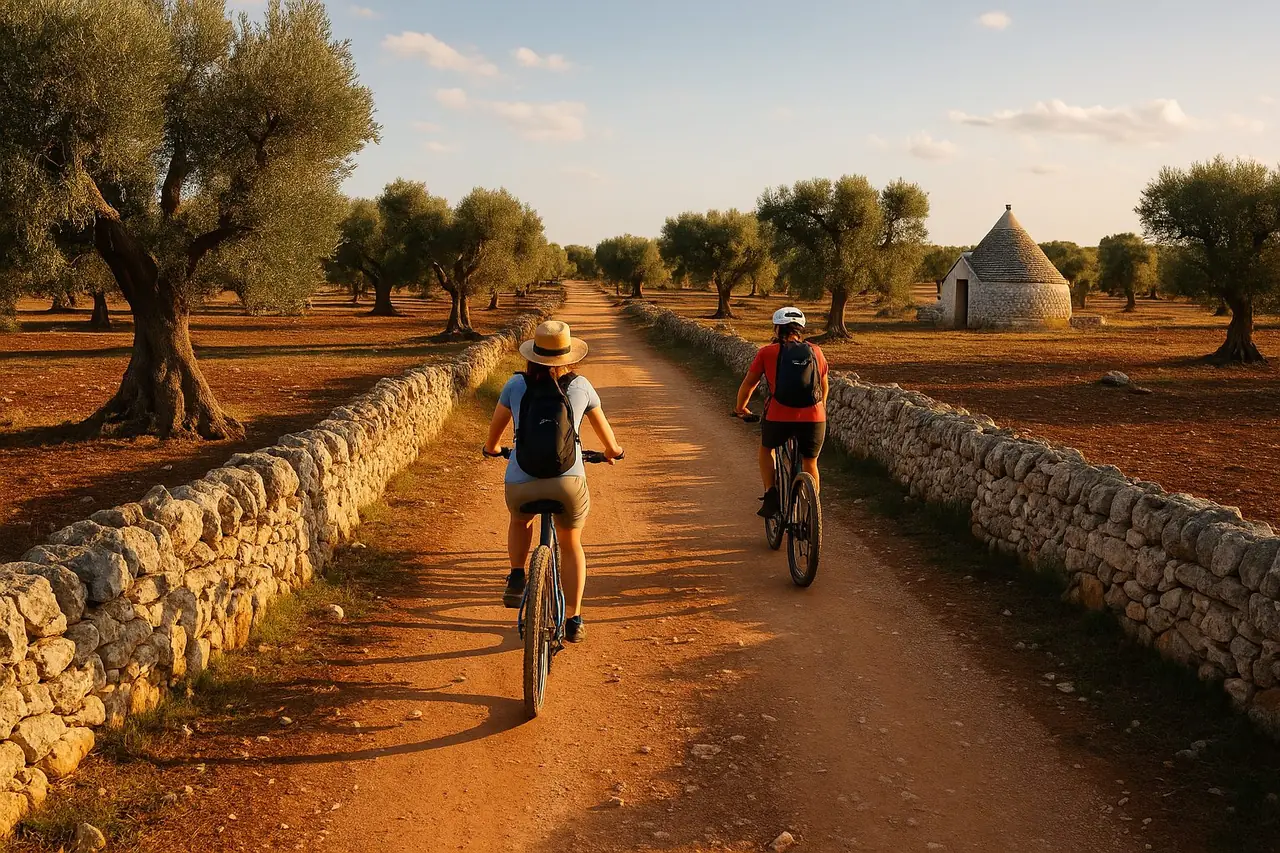
Valle d'Itria's towns sit close enough together that a loop from Alberobello to Locorotondo and Martina Franca is a realistic day ride rather than a stretch: Alberobello to Locorotondo is 9 km (5.6 miles), Locorotondo to Martina Franca a further 7 km (4.3 miles), and the road back from Martina Franca to Alberobello another 15 km (9.3 miles) — about 31 km (19 miles) in total, on secondary roads through olive groves, vineyards and dry-stone field walls rather than the SS172 main road.
Terrain across the area is gently rolling rather than flat. Comparable mapped loops of similar length around Alberobello show elevation gains in the 150-250 m range, mostly as several short rises rather than one long climb, and surfaces described as mostly paved secondary tarmac. Route data mapped specifically for this Locorotondo-Alberobello-Martina Franca loop shows a total elevation gain of 251 m; treat the road surface as a planning estimate rather than a surface we've checked in person. Refill water bottles in the main piazza of each of the three towns — there's little in between them.
Rent the right bike for this kind of route through our bike rental in Puglia — road or gravel both handle the paved sections fine, and an e-bike takes the edge off the rolling terrain if you're combining all three towns in one day. Alberobello sits outside our free-delivery area (Lecce, San Foca and Calimera only), but ask us about arranging delivery here for your dates.
Getting to Alberobello
By car, Alberobello is around 110 km (68 miles) from Lecce, about 1 hour 20 minutes via the SS613 and SP toward Martina Franca. There's no direct train from Lecce: Alberobello is on FS Sud Est's Bari-Taranto line (the operator formerly branded Ferrovie del Sud Est), so getting there from Lecce means at least one change. Parts of the FS Sud Est network are under electrification works, and the Francavilla Fontana-Lecce section has been served by replacement buses since 10 June 2024, according to the Regione Puglia transport press office — so part of the journey may be by bus. Whether and when this section reopens to full rail service can change, so check current timetables on the official FS Sud Est site before you travel rather than relying on a fixed schedule.
For visitors basing themselves in Lecce or along the Salento coast, Alberobello works better as part of a Valle d'Itria loop than as a single-town day trip from that far south — pairing it with Ostuni, 35 km away, or with Locorotondo and Martina Franca as covered above, makes better use of the drive or ride. For the wider picture of how Valle d'Itria fits with the rest of the region, see our guide to cycling in Puglia.
FAQ
How many days do I need in Alberobello? Half a day covers the historic centre — Rione Monti, Aia Piccola, Trullo Sovrano, Chiesa di Sant'Antonio and Casa d'Amore are all within a 10-minute walk of each other. Add a full day if you're combining it with the Locorotondo-Martina Franca bike loop.
Is Alberobello worth visiting for one day? Yes, for the historic centre alone. It gets busy with coach groups around midday, so an early morning or late afternoon visit gives a quieter look at Rione Monti and Aia Piccola without changing what there is to see.
Can you visit the trulli for free? Walking through both trulli districts, Rione Monti and Aia Piccola, is free at any time — they're residential and commercial streets, not a ticketed site. Only the Trullo Sovrano house-museum charges an entry fee.
Is Alberobello's centre walkable, and where do you park? Yes — the centre is compact, and Rione Monti, Aia Piccola and the main sights sit within 800 m of Piazza del Popolo. Car parks ring the edge of the historic centre; check current signage and pricing on arrival, since zones and rates change.
How do I get from Lecce to Alberobello without a car? By regional service via FS Sud Est (formerly Ferrovie del Sud Est), with at least one change — there's no direct Lecce-Alberobello train. Part of the route is currently covered by replacement buses while the Francavilla Fontana-Lecce section is being electrified, so check current timetables on the official FS Sud Est site before travelling.
What's the best time of year to visit Alberobello? April-June and September-October give the mildest weather and fewer coach groups. July-August is hot and the streets around Rione Monti get crowded by mid-morning; November-March is quiet, though some attractions reduce their hours.
Riding between the trulli : if you're combining Alberobello with Locorotondo, Martina Franca or Ostuni, tell us your route and dates — we'll match you to a bike suited to the terrain and talk through delivery options, since Alberobello sits outside our free-delivery zone of Lecce, San Foca and Calimera.