
What to See and Do in Ostuni, Puglia's White City
By Eugenio TommasiUpdated 17 August 2026 10 min read
Key facts
- Best for
- Whitewashed old town on a hilltop, a Gothic cathedral, and one of the oldest documented burials in Europe
- Time needed
- Half a day for the old town and museum; a full day with the archaeological park or a ride to the coast
- Getting around
- On foot in the old town (steep, stepped streets in places); bike or car for the countryside and coast
- Distance from Lecce
- 77 km (48 miles), about 1 hour 5 minutes by car
- Distance from Brindisi Airport
- around 38 km (24 miles), about 37 minutes by car
- Distance from Bari
- 86 km (53 miles), about 1 hour 15 by car
- When to go
- April-June and September-October for mild weather; the weekly market fills the Area Mercatale on Via Nino Sansone
Ostuni's old town: what to see first
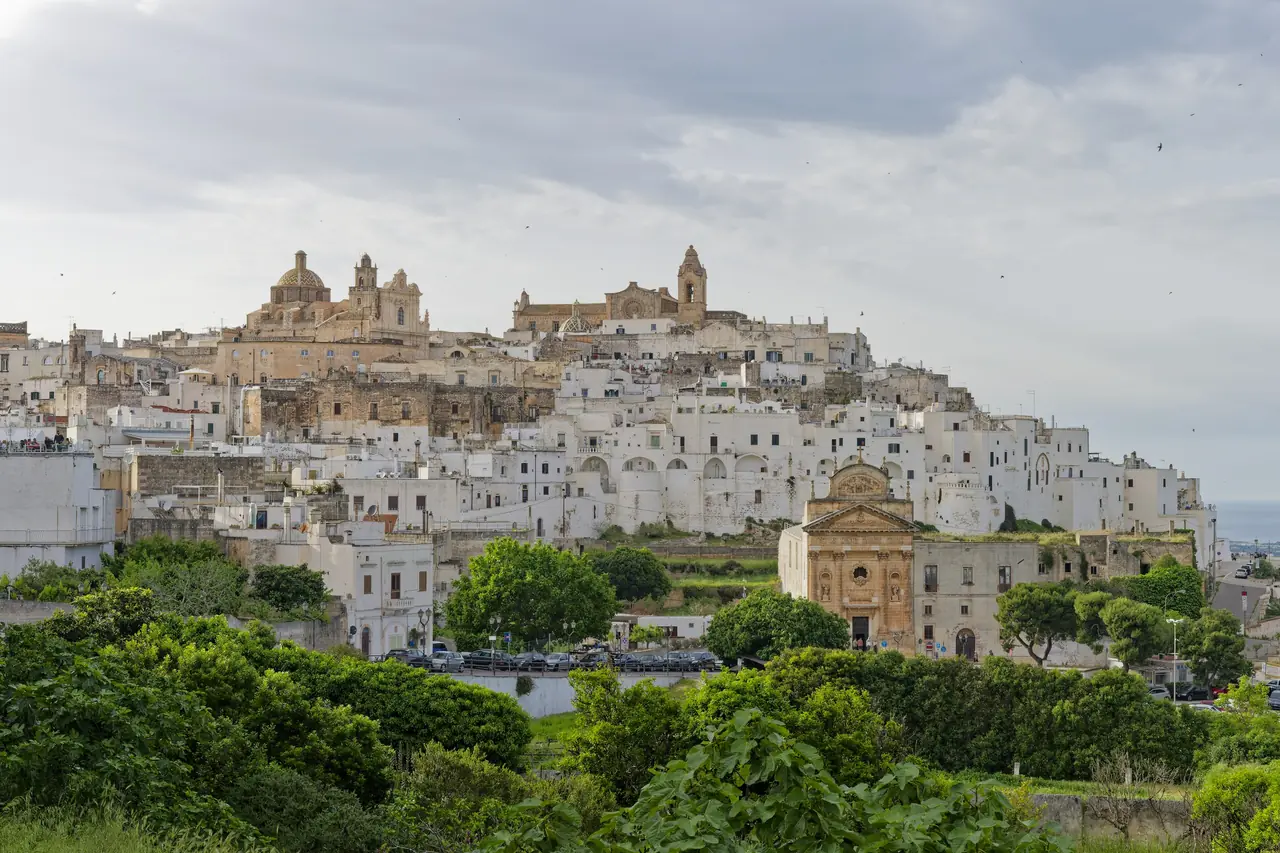
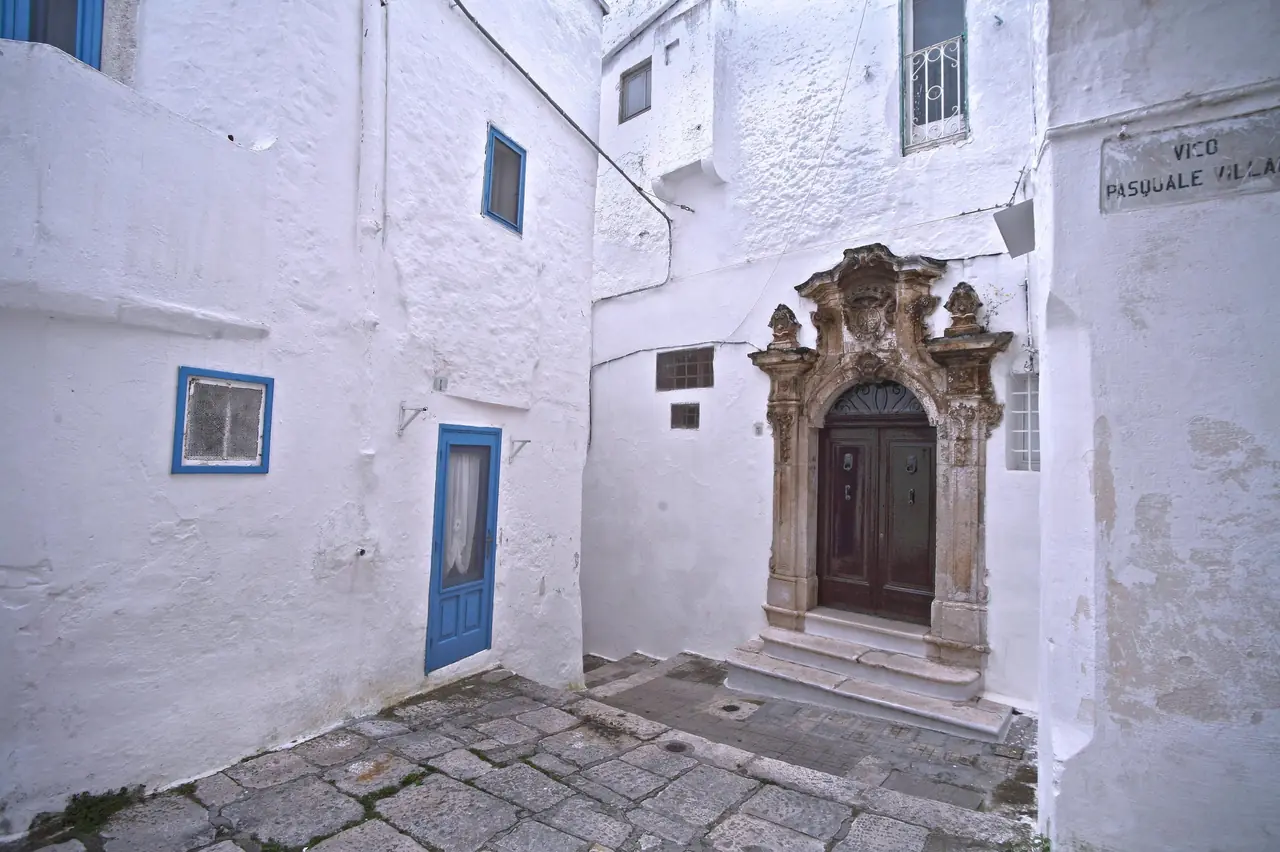
Ostuni is called "the White City" because its historic centre — locally "La Terra" — is a hill of lime-whitewashed houses built directly on and into the rock, climbing three low hills at 218 m (715 ft) above sea level. From the surrounding olive groves, the white mass of the old town is visible from several kilometres away, well before any single building resolves into view; up close, the whitewash covers narrow stepped alleys, arches built between houses to support them, and small courtyards rather than a single uniform facade. The origins go back to the Messapian era, with later Roman and medieval building layered on top, according to the Comune di Ostuni.
The centre is pedestrian and largely traffic-free, and the streets are genuinely steep in places — comfortable shoes matter here more than in the flat old towns further south in Salento. Piazza della Libertà, at the base of the climb, is the natural starting point; from there, Via Cattedrale runs uphill to the cathedral at the top of the hill, passing most of what's covered below. The coast is a short ride away — see Seeing Ostuni by bike below for real distances.
Riding this route on one of our bikes? Start from our bike hire in Puglia — delivery, sizes and prices are all there.
The historic centre, sight by sight
Piazza della Libertà and the Colonna di Sant'Oronzo
What it is
the old town's main square, where the historic centre meets the newer part of town. At its centre stands the Colonna di Sant'Oronzo, a 20-metre stone column erected in 1771 by the sculptor Giuseppe Greco.
Why it's worth it
the column isn't purely decorative — it was raised as a votive offering after Ostuni was spared by an 18th-century plague outbreak, a piece of documented civic history rather than a generic monument.
Practical
open public square, free, accessible at any time.
Getting there
the starting point for the old town — most car parks and the bus link from the railway station drop off within walking distance.
Practical note
Ostuni's weekly market sets up nearby at the Area Mercatale on Via Nino Sansone, the site the Comune di Ostuni designates for weekly markets and traditional fairs (verified August 2026). The Comune doesn't publish the market day or its hours, so check locally for current market days before planning around it.
Cattedrale di Santa Maria Assunta
What it is
the 15th-century cathedral at the highest point of the old town, dedicated to the Assumption of the Virgin Mary — Cattedrale di Santa Maria Assunta is the official name used by the Comune di Ostuni. The facade is Gothic, with a Baroque interior, according to the Comune di Ostuni.
Why it's worth it
the rose window on the facade is regularly described by regional sources as the second-largest of its kind in Europe — a claim repeated widely in Puglia but that we haven't been able to trace to a primary architectural source, so treat it as a well-known local claim rather than a verified ranking. What's certain is that the cathedral marks the physical high point of the old town, the spot the whole white hill is built around.
Practical
entry is generally free; specific public opening hours weren't published by the Comune di Ostuni, the Diocese of Brindisi-Ostuni or the parish as of August 2026. Hours and prices can change, so confirm before you visit. Address: Piazza Beato Giovanni Paolo II.
Getting there
a short, steadily uphill walk from Piazza della Libertà along Via Cattedrale — no more than a few hundred metres, but steep enough to feel it in summer heat. No bike or car access inside the pedestrian centre.
Practical note
the cathedral has wheelchair-accessible ramps at its entrance, per the Comune di Ostuni — one of the few fully step-free points in the old town.
Arco Scoppa
What it is
an elevated stone passageway directly opposite the cathedral, in Largo Trinchera, connecting the Palazzo Vescovile (Bishop's Palace) to the Palazzo del Seminario (Seminary). Locally it's known simply as "la Loggia."
Why it's worth it
it was originally built in wood and rebuilt in stone in 1750 for durability — one of the few structures in the old town with a documented construction date. It's often compared locally to Venice's Bridge of Sighs for its enclosed shape, a visual comparison rather than a claim of shared architects or origin. From beside it, the ground drops away toward the olive groves below.
Practical
a public passageway, freely visible and walkable at any time, no ticket required.
Getting there
at the top of the old town, right beside the cathedral — the same short uphill walk from Piazza della Libertà.
Practical note
this is also one of the better points in town for the view over the olive groves toward the Adriatic, without needing to leave the historic centre.
Chiesa di San Vito Martire and the Museo Civico
What it is
an 18th-century Baroque church, built 1750-1752, that formed part of a Carmelite convent. The building now houses Ostuni's civic archaeological museum — the Museo delle Civiltà Preclassiche della Murgia Meridionale — which opened in 1989 and reopened with an expanded layout in 2011, per ostunimuseo.it.
Why it's worth it
the museum holds the original remains of "Ostuni 1," a woman buried around 26,461-26,115 BC in a crouched position, one hand under her head and the other on her belly — she was pregnant, which makes the burial one of the oldest documented pregnancies known anywhere. A cast of a second burial, Ostuni 2 (about 28,200-27,568 BC), is also on display, alongside grave goods and a reconstruction of the original cave environment.
Practical
open Monday-Friday 10:00-14:00 and 16:00-19:00, Saturday-Sunday 10:00-19:00. Admission €5 full price, €3 reduced (groups over 12, over-65s, university students with ID); free under 6 and for visitors with disabilities and their companion. All figures from ostunimuseo.it, verified 19 August 2026. Opening hours change seasonally — check the official site before you go. Address: Via Cattedrale 15.
Getting there
on Via Cattedrale, the same street leading up to the cathedral — a short walk from Piazza della Libertà.
Practical note
the original excavation site, where Ostuni 1 was actually found, is a separate location outside town — see the archaeological park below.
Ostuni 1: the Paleolithic woman and the archaeological park
The remains on display at the Museo Civico were excavated at a separate site: the Parco Archeologico e Naturalistico di Santa Maria d'Agnano, a cave and its surrounding park about 2 km (1.2 miles) from the old town, in Contrada Agnano off the SS16 toward Fasano. The cave was used for burial and ritual purposes from the Paleolithic period onward, according to the Comune di Ostuni, and it's where both Ostuni 1 and Ostuni 2 were excavated — the finds now displayed at Via Cattedrale 15.
That split — an excavation site outside town and the finds themselves inside it — is easy to miss when planning a visit, since most general guides mention only "the Ostuni 1 museum" without noting that the burial itself happened elsewhere. If Ostuni 1 is the reason for your visit, both locations are worth the trip.
The park is open Sundays and public holidays, 09:00-13:00, or by reservation via info@ostunimuseo.it or +39 0831 336383, per ostunimuseo.it (verified 19 August 2026). The same source notes it's reachable by private vehicle only — there's no bus to the gate. A ticket price for the park on its own wasn't published. Hours and prices can change, so confirm before you visit. Outside those Sunday and holiday mornings it's a reservation-only site rather than a walk-in one, so arrange ahead if it's central to your plans.
Beyond the walls: olive groves, wine and the coast
Ostuni's old town sits on its hill surrounded by olive groves that stretch toward the Adriatic — the same groves that make the white town visible from a distance, described above. The land around Ostuni also falls inside the Ostuni DOC (Denominazione di Origine Controllata), a wine designation distinct from Valle d'Itria's better-known whites further inland. The delimited zone covers the municipalities of Ostuni, Carovigno, San Vito dei Normanni and San Michele Salentino, plus parts of Latiano and Ceglie Messapica, all in the province of Brindisi. Ostuni DOC covers both Ostuni Bianco and Ostuni Ottavianello (also called Ottavianello di Ostuni), a dry, ruby-red wine made from at least 85% Ottavianello grapes, per the Regione Puglia quality productions register (verified 19 August 2026). For a broader look at the region's wine areas, including Valle d'Itria, see our wine tasting in Puglia guide.
Ostuni also sits within reach of Valle d'Itria's other hill towns — Alberobello is 35 km (22 miles) away — which makes it realistic to combine an Ostuni visit with the trulli of Alberobello.
Seeing Ostuni by bike
Ostuni's old town sits at 218 m (715 ft) above sea level, about 7.5 km (4.7 miles) from the Adriatic coast in a straight line — which sets up a genuine route, not just a token bike mention: down through the olive groves to the coast at Torre Canne, and back up.
Route: Ostuni old town to Torre Canne and back
| Detail | Value |
|---|---|
| Distance one way | About 19.5 km (12.1 miles) by road |
| Distance round trip | About 39 km (24 miles) |
| Elevation | A net drop of roughly 218 m from the old town to sea level heading out, and the same climb back — the road undulates rather than descending in a straight line, so expect short rises even on the way to the coast |
| Surface | Paved secondary roads through olive groves for most of the way |
| Water | Fill bottles in Piazza della Libertà before setting off — there's little reliably open between the old town and the coast outside peak summer |
| Time | Roughly 1-1.5 hours each way at a relaxed pace on a road or gravel bike |
This route was mapped using road-routing data rather than ridden by us in person, since it isn't one we cover regularly from our Lecce base: about 18.96 km one way from the old town to Torre Canne, with a net elevation drop of around 222 m from hilltop to coast. Road surface conditions haven't been checked in person, so confirm locally before relying on it with a group on narrow tyres.
Rent the right bike for this kind of route — road or gravel handles the paved sections fine, and an e-bike takes the edge off the return climb — through bike rental in Puglia. We don't offer paid delivery to your accommodation (free pickup in our shops) to Ostuni; tell us your accommodation, including a masseria in the surrounding countryside, and we'll quote the delivery cost before you book. For where else you can ride in the region, see our cycling in Puglia guide.
How much time do you need in Ostuni?
| Time available | What you can realistically cover |
|---|---|
| 2-3 hours | Piazza della Libertà, the Colonna di Sant'Oronzo, the cathedral and the Arco Scoppa — the core loop through the old town |
| Half a day | The above, plus the Museo Civico and the story of Ostuni 1 |
| Full day | Old town and museum, plus a bike ride to the coast or the archaeological park at Santa Maria d'Agnano (reservation only) |
Ostuni pairs naturally with the rest of Valle d'Itria on a longer trip — see the best places to visit in Puglia for how it fits alongside Alberobello, Locorotondo and Martina Franca.
Getting to Ostuni without a car
Ostuni has its own railway station on the Bari-Lecce line. Trenitalia's fast regional service ("collegamento veloce") connects Lecce and Bari calling at Brindisi, Ostuni and Monopoli — check current timetables on Trenitalia's official page before you travel, since schedules change.
The station itself sits about 2.7 km (1.7 miles) from the old town, down the hill — not walking distance with luggage. A dedicated "Ostuni Link" bus connects the station to the historic centre: it's run by STP Brindisi and sold by Trenitalia alongside the train ticket, at €1.10 for a single journey on top of the rail fare, per Trenitalia's official page (verified 19 August 2026). The bus leaves from in front of the station. A taxi covers the same distance in a few minutes if you'd rather not wait.
FAQ
What is the best time of year to visit Ostuni? April-June and September-October offer mild weather and fewer crowds. July-August gets hot, and the old town's narrow streets get busy in the middle of the day; November-March is quiet, but some sites reduce their hours.
Is Ostuni's old town accessible for wheelchairs or pushchairs? Only partially. Many streets in the historic centre are stepped or cobbled and climb steeply. The cathedral has ramps at its entrance, but this isn't representative of the wider old town.
Can I visit Ostuni without a car? Yes — Ostuni has a railway station on the Bari-Lecce line, with a bus link ("Ostuni Link") to the old town, and Alberobello and the rest of Valle d'Itria are within a short drive or ride if you're travelling on by bike.
Is there parking near Ostuni's old town? The historic centre is pedestrian, so cars park in areas around the base of the hill. We haven't verified current paid or free parking zones from an official source, so check local signage or the municipality's site when you arrive.
Is Ostuni suitable for a family visit with children? The old town is compact and largely traffic-free, which makes it safe to walk, but the steep, stepped alleys aren't ideal with a pram — a carrier works better than a pushchair on the steepest stretches.
How does Ostuni compare to Alberobello or Lecce? Ostuni is a hilltop town built around a Gothic cathedral and a Paleolithic archaeological story; Alberobello is flatter and known for its trulli; Lecce, our home base, is a larger Baroque city on the flat Salento coast. See the best places to visit in Puglia for how the three compare.
Riding around Ostuni or Valle d'Itria? We deliver bikes here from our Lecce base — road, gravel or e-bike, matched to how much climbing you want to do on the way back from the coast. Delivery to Ostuni isn't free, but we quote it for any address, including a masseria in the countryside, once you tell us your dates.