
Things to Do in Lecce: Old Town Sights, Museums and the Ride to the Coast
By Eugenio TommasiUpdated 17 August 2026 10 min read
Key facts
- Best time to visit
- April, May and October — mild weather (average daily highs 19-25°C), fewer crowds; June and September are warm shoulder months, July-August averages above 32°C
- Time needed
- A full day on foot for the six sights below; two days if you add the coast by bike
- Getting around
- On foot in the old town — everything below is a 10-15 minute walk from Piazza Sant'Oronzo; by bike for the coast, 12-20 km away
- Approximate cost
- Free to view from outside (Anfiteatro Romano, Porta Napoli, Piazza Duomo); LeccEcclesiae combined ticket for the Duomo and Basilica di Santa Croce from €11; €5 to walk into the amphitheatre excavations; €10 for the Castello Carlo V guided tour
- From Brindisi airport
- 46 km (29 miles) by road, around 40 minutes by car; no direct train from the airport — check Trenitalia for connections via Brindisi station
- From Bari
- 151-161 km (94-100 miles), around 1 hour 50 by car
What to see in Lecce's old town
Lecce's historic centre is small and flat, built almost entirely from pietra leccese, a soft local limestone that carves easily and turns a warm honey colour with age — the reason the city is sometimes called the "Florence of the South." The six sights covered below sit within a few streets of each other around Piazza Sant'Oronzo and Piazza Duomo, so you can walk between all of them without planning a route. Smaller Baroque churches, such as Chiesa di Sant'Irene near Piazza Sant'Oronzo, fill the same few streets if you want to keep going after the main sights.
If Lecce is one stop on a longer trip, see things to do in Puglia for how it fits with the rest of the region, or the best places to visit in Puglia for an area-by-area breakdown.
We're based here, on Via Francesco Ribezzo 2D, a short walk from Piazza Sant'Oronzo — most of what follows is reachable on foot from our shop.
Riding this route on one of our bikes? Start from our bike rental in Lecce with delivery — delivery, sizes and prices are all there.
Basilica di Santa Croce
What it is
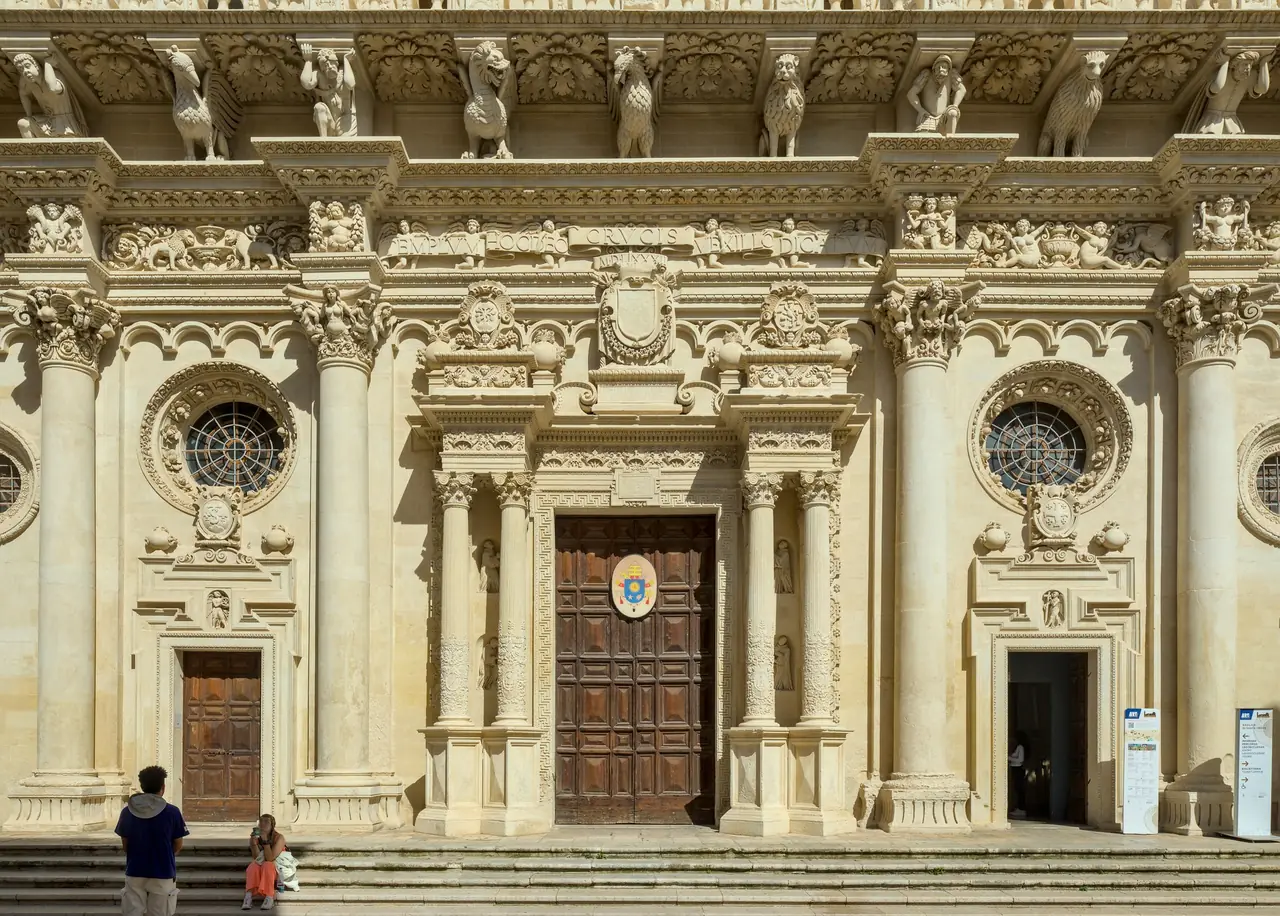
A Franciscan church on Corso Umberto I, built between 1549 and 1646. Gabriele Riccardi drew up the original layout and finished the lower order by 1582; Francesco Antonio Zimbalo added the portals bearing the arms of the Brienne, the D'Enghien and Philip III of Spain from 1606; the upper façade and rose window are by Cesare Penna, and the top decorations by Giuseppe Zimbalo. It's the building most associated with Lecce Baroque.
Why it's worth it
The facade is carved with telamons — figures and animals supporting a wide balcony — and took close to a century to finish, which shows in how the style shifts from the restrained lower order to the denser upper decoration.
Practical
Open 9:00-21:00 from April to September, 9:00-18:00 from October to March, last entry 15 minutes before closing. Entry is via the LeccEcclesiae circuit ticket. The standard ticket — Duomo, Basilica di Santa Croce, Chiesa di Santa Chiara, Chiesa di San Matteo, the Antico Seminario and the MuDAS museum of sacred art — is €11 full / €5 (ages 12-17) / €24 family. The extended ticket, which adds the Campanile, is €21 / €13 / €48. Source: chieselecce.it. Hours and prices can change, so confirm before you visit.
Getting there
On Corso Umberto I, a 5-minute walk from Piazza Sant'Oronzo.
Duomo di Lecce and Piazza Duomo
What it is
The city's cathedral, dedicated to Santa Maria Assunta, rebuilt in 1659-1670 by the Lecce-born architect Giuseppe Zimbalo (known as "lo Zingarello") for Bishop Luigi Pappacoda. The adjoining bell tower, also by Zimbalo, was built between 1661 and 1682 to replace an earlier Norman-era tower that had collapsed. Piazza Duomo, the square around it, is enclosed on three sides and considered one of the more complete Baroque squares in Italy.
Why it's worth it
The square itself is free to enter and, unlike most piazzas in Lecce, has only one entrance — which is part of why it feels enclosed rather than passed-through.
Practical
The piazza is open at all times, free. Entering the Duomo needs the LeccEcclesiae ticket described above, from €11; the Campanile is included only on the extended €21 ticket. Sites open 9:00-21:00 April to September, 9:00-18:00 October to March. The central ticket office is inside the Antico Seminario, Piazza del Duomo 5. Source: chieselecce.it. Opening hours change seasonally — check the official site before you go.
Getting there
A 3-minute walk from the Basilica di Santa Croce, along Via Vittorio Emanuele II.
Anfiteatro Romano and Piazza Sant'Oronzo
What it is
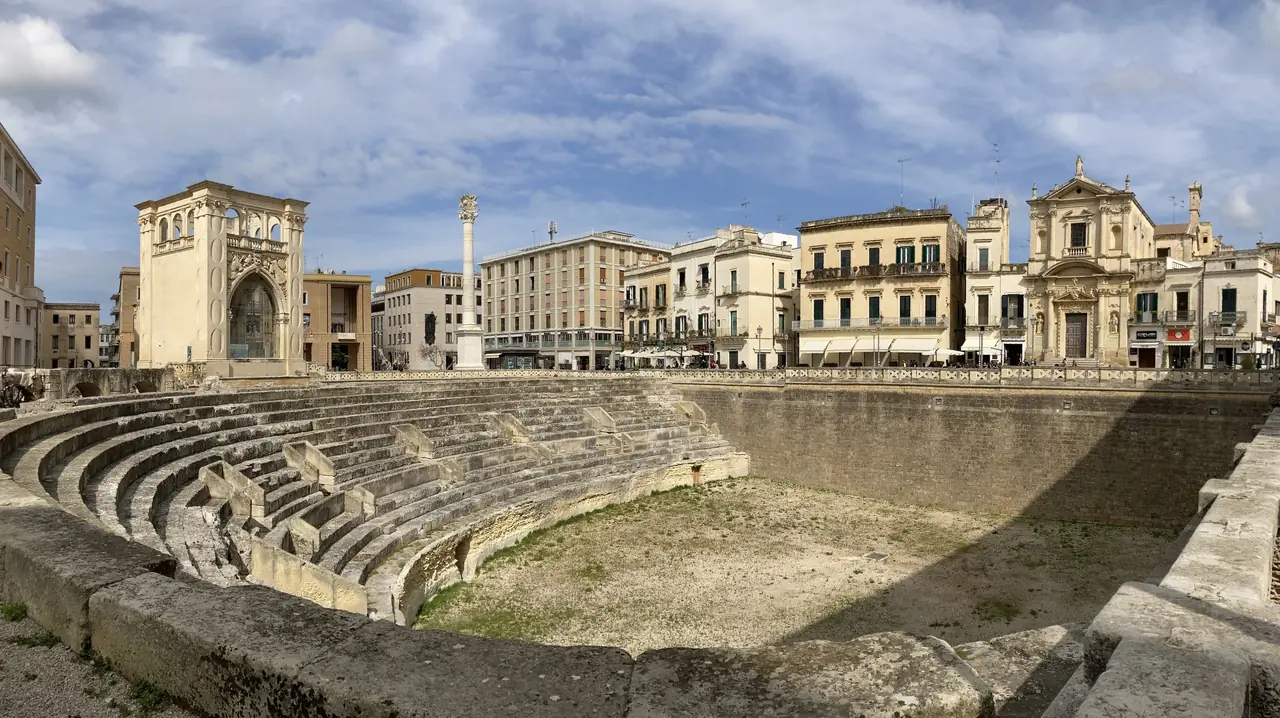
A Roman amphitheatre built in the Augustan age (1st century AD) and remodelled about a century later under Hadrian. Excavations began in 1900, led by the archaeologist Cosimo De Giorgi, during the demolition of the Isola del Governatore to make way for the Bank of Italy building — the structure was already recorded in historical sources rather than being a chance find. It measured about 102 x 82 m and held an estimated 12,000 to 14,000 spectators. Its outer wall had 68 arches, of which 24 pillars survive. About a third of it is visible today; the rest lies under the square and surrounding buildings.
Why it's worth it
It sits in the middle of the modern town rather than on the outskirts, which is unusual — you can see 2,000-year-old stonework a few steps from the cafés on Piazza Sant'Oronzo. The Colonna di Sant'Oronzo, on the same square, is a 17th-century column (built 1666-1686 to a design by Giuseppe Zimbalo) made from the shaft of one of the two Roman columns that once marked the end of the Via Appia in Brindisi.
Practical
The amphitheatre is visible free from the piazza at any time, and the excavated area can also be visited on a ticket: €5 full, €2 reduced. Open Tuesday to Sunday, 10:00-17:00 from October to March and 15:00-21:00 from April to September, last admission 30 minutes before closing. Managed by the Direzione regionale Musei nazionali Puglia (Ministry of Culture). Source: museipuglia.cultura.gov.it, checked 19 August 2026.
Getting there
The square is the centre of the old town — a 2-minute walk from the Duomo.
Museo Faggiano
What it is
A private house on Via Ascanio Grandi that became an archaeological museum by accident. In 2001, owner Luciano Faggiano started breaking up the floors to fix an old drainage problem and kept finding things underneath instead. The excavation that followed uncovered structures from several historical periods, starting with the Messapians — tombs, cisterns, granaries and passageways layered on top of each other. Source: comune.lecce.it, checked 17 August 2026.
Why it's worth it
It's the one sight on this list that wasn't designed to be seen — you're walking through what a family found under their own house, in the order they found it.
Practical
Open daily 9:30-20:00. Tickets €5 full, €3 (ages 8-16), free under 8. Address: Via Ascanio Grandi 56. Source: museofaggiano.it, checked 19 August 2026.
Getting there
A 5-minute walk south of Piazza Sant'Oronzo.
Castello Carlo V
What it is
A fortress that Emperor Charles V ordered built in 1539 to replace an inadequate medieval stronghold, as part of a wider programme to defend Puglia's coast against Ottoman raids. It was designed by Gian Giacomo dell'Acaya, chief military engineer of the Kingdom of Naples, and its outer walls and four bastions were completed by 1549.
Why it's worth it
It's a working example of 16th-century military architecture rather than a ruin — the bastion layout ("fiancheggiati alla moderna") was advanced for its time, built specifically to withstand cannon fire rather than older siege methods.
Practical
Open Tuesday-Sunday, 10:00-20:00. The castle can only be seen on an accompanied tour, which lasts about 50 minutes and leaves on fixed turns: 10:30, 11:30 and 12:30, then hourly from 15:00 to 19:00 between June and September, or from 16:00 to 19:00 between October and May. The last tour leaves at 19:00. Tickets €10 full, €6 (ages 12-17), €6 for groups of 15 or more, free under 12. Source: ilcastellodilecce.it, checked 19 August 2026 — temporary exhibitions inside the castle have separate pricing and change through the year, so check the official site for what's on.
Getting there
A 7-minute walk from Piazza Sant'Oronzo, on the southern edge of the old town.
Porta Napoli
What it is
A triumphal arch built in 1548 in honour of Charles V, on the site of the older Porta San Giusto. It was commissioned by the marquis Ferrante Loffredo and designed by Gian Giacomo dell'Acaya — the same engineer behind the Castello Carlo V. A round arch flanked by Corinthian columns is topped by a triangular pediment carrying the royal coat of arms and a crowned eagle.
Why it's worth it
Lecce originally had four gates; Porta Napoli, Porta Rudiae and Porta San Biagio survive, and this is the most complete of the three, still standing more or less as built.
Practical
A public monument, viewable at any time, no ticket.
Getting there
A 10-minute walk north of Piazza Sant'Oronzo, at the edge of the old town — the natural point to start or finish a walk through the centre.
Seeing Lecce by bike
The flattest, most direct way to reach the coast is the route linking Torre Specchia, San Cataldo, Frigole and the Riserva Naturale Statale Le Cesine, a coastal wetland reserve managed as a WWF oasis: 22.5 km (14 miles) point-to-point, with around 15 m of climbing, mostly on asphalt with two short sections of compacted gravel. It's pan-flat, so it's comfortable on an e-bike or riding with kids. It's not a loop back into Lecce — it runs between the four places above, so plan your start and finish points around that. It's the same route we use for our half-day guided rides, ridden at a relaxed pace in around 1-1.5 hours in the saddle, not counting stops.
The gravel sections are short and manageable on a gravel bike like the Checkpoint ALR; on a pure road bike like the Domane AL you'll want to slow down through them rather than take them at speed. San Cataldo and Frigole both have bars where you can refill a water bottle in season — outside peak season, fill up before you leave the shop.
Rent the right bike for this route through our bike rental in Lecce, with paid delivery to your accommodation (free pickup in our shops) to your accommodation in Lecce, San Foca or Calimera.
If you'd rather cover more ground, the coast road also connects onward to Lecce's wider cycling network in Puglia, including longer rides to Otranto and Gallipoli covered in our Salento travel guide.
How many days do you need in Lecce?
| Time available | What you can realistically see |
|---|---|
| Half a day | Basilica di Santa Croce, Duomo di Lecce, Anfiteatro Romano — the three central sights, all on foot |
| A full day | Add Museo Faggiano, Castello Carlo V and Porta Napoli |
| Two days | Add the Torre Specchia – San Cataldo – Frigole – Le Cesine bike route, or a day trip to Otranto or Gallipoli |
Two days covers Lecce properly without rushing. If you're staying longer, Otranto (47 km, flat) and Gallipoli (39 km, flat) are both realistic day trips by bike or car — see the best places to visit in Puglia for what's in each town.
Getting to and around Lecce
Lecce's main railway station, on Viale Oronzo Quarta, is about a 15-minute walk south of the old town, with regional trains from Brindisi, Bari and further afield — check Trenitalia for timetables rather than relying on a fixed schedule here, since routes change seasonally. Brindisi's airport, the region's main one, is 46 km (29 miles) away by road, about 40 minutes by car; there's no direct train, so budget close to an hour door-to-door once you account for the connection.
The old town itself is pedestrian-heavy and best seen on foot or by bike — narrow streets and limited traffic access make a car impractical once you're inside the historic centre. If you're driving in, look for paid parking (strisce blu) just outside the old town walls rather than trying to find space within them.
FAQ
How many days do I need in Lecce? Two days covers the six sights in this guide plus a bike ride to the coast without rushing. A half-day is enough for the three central landmarks — Basilica di Santa Croce, Duomo di Lecce and the Anfiteatro Romano — if you're short on time.
Is Lecce walkable, or do I need a car? The old town is flat and compact — everything in this guide is within a 10-15 minute walk of Piazza Sant'Oronzo. A car isn't useful inside the historic centre; a bike is the practical option if you want to reach the coast.
What is Lecce known for? Its concentration of 17th-century Baroque architecture carved from local limestone, pietra leccese — the reason it's sometimes called the "Florence of the South." The Basilica di Santa Croce is the building most associated with the style.
Can I cycle from Lecce to the sea? Yes. The nearest coast, at San Cataldo and Frigole, is reachable on the 22.5 km Torre Specchia – San Cataldo – Frigole – Le Cesine route described above, pan-flat and mostly asphalt with two short gravel sections. It runs point-to-point between those places rather than looping back into Lecce, so plan your start and finish accordingly. Otranto and Gallipoli are further, flat rides for a longer day out.
What happens if I have a mechanical problem during a ride? Every rental bike leaves with a repair kit and spare inner tube for small fixes. For anything more serious, our mechanics support you from our Lecce base — tell us where you are and we'll sort it out.
What's the best time of year to visit Lecce? April, May and October give the mildest weather and fewer crowds, with average daily highs of 19-25°C. June and September are warm rather than mild, and July-August averages above 32°C and is busy; November-March is quiet, though some sites reduce their hours.
Riding these sights, or heading to the coast? Pick up a bike at our shop on Via Francesco Ribezzo 2D, or tell us where you're staying — free pickup at our shops in Lecce, San Foca and Calimera, or paid delivery to your accommodation, with a helmet and repair kit included on every bike.