
Things to Do in Taranto: Two Seas and Old Town
By Eugenio TommasiUpdated 18 August 2026 9 min read
Key facts
- Best for
- The Città Vecchia island between two seas, a working 19th-century swing bridge, and one of Italy's major archaeological museums
- Time needed
- Half a day for Città Vecchia, the Castello Aragonese and MArTA; a full day to add the Lungomare Vittorio Emanuele III on foot or by bike
- Getting around
- On foot in Città Vecchia (narrow alleys, some uneven paving and steps); on foot or by bike along the Lungomare Vittorio Emanuele III in Borgo Nuovo
- Indicative cost
- MArTA €10 full / €2 (18-25) / free under 18; Castello Aragonese guided tours free; Cattedrale di San Cataldo free entry
- Distance from Lecce
- About 108 km (67 miles), around 1h30 by car; direct trains run too — check current times on Trenitalia
- Distance from Bari
- About 94 km (58 miles), around 1h15 by car
- When to go
- April-June and September-October for mild weather; MArTA is free on the first Sunday of every month
Città Vecchia: an island between two seas
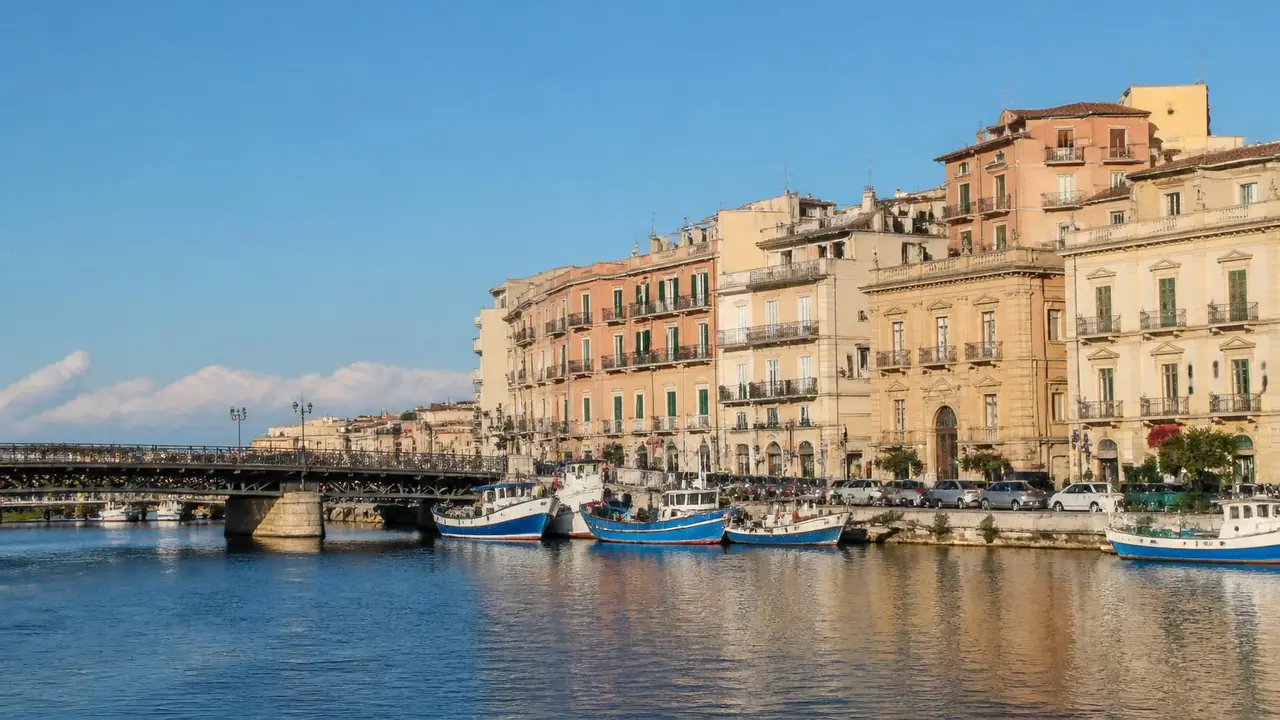
Taranto's old town, Città Vecchia, sits on a small island of roughly 30 hectares (74 acres) wedged between the Mar Grande, the outer bay open to the Ionian Sea, and the Mar Piccolo, an almost fully enclosed inner basin. According to local historical sources, the island was settled by Spartan colonists in 706 BC, and as late as 1746 it held the entire population of Taranto — the "new town," Borgo Nuovo, on the mainland is a later expansion. Two bridges connect the island to the mainland: the Ponte Girevole to the north-east, covered below, and the older stone bridge, the Ponte di Porta Napoli, to the west — still treated by residents as the old town's true gate. Taranto's third and much longer bridge, the 1,909 m Ponte Punta Penna Pizzone, crosses the Mar Piccolo between Punta Penna and Punta Pizzone and doesn't touch the island at all, which is a common point of confusion.
The streets are narrow, stepped in places, and built up over more than two millennia of Greek, Roman, Byzantine, Norman and Aragonese layers — a level of density that gives Città Vecchia its underground cellars and covered passages as much as its street-level facades. Large parts of the island have been depopulated over recent decades, and some buildings sit closed and visibly in need of repair alongside restored ones; regeneration projects are ongoing, and the district is a genuinely mixed picture rather than a fully restored showpiece. That's worth knowing before you go rather than after: it makes for an interesting, unpolished walk, not a curated one.
Riding this route on one of our bikes? Start from our bike rental in Puglia — delivery, sizes and prices are all there.
Mar Grande, Mar Piccolo and the black mussels
The nickname "Città dei Due Mari" (city of the two seas) isn't marketing — it describes a real hydrography. The Mar Grande is the open bay facing the Ionian Sea; the Mar Piccolo is a shallow, largely enclosed lagoon-like basin behind the old town, fed partly by freshwater springs (citri) rising from the seabed. The two are linked by the navigable channel that the Ponte Girevole crosses.
The Mar Piccolo has been farmed for mussels for centuries: documented references to the local black mussel — cozza nera di Taranto, or cozza tarantina — date back to at least 1525, and the mollusc is now a Slow Food Presidio, according to the Fondazione Slow Food. The traditional farming method uses ropes hung from wooden or metal frames (pali) driven into the shallow basin — a technique fishing families here refined well before industrial aquaculture existed elsewhere. You'll see the frames from the Lungomare Vittorio Emanuele III and from several points around the Mar Piccolo shoreline.
Taranto, sight by sight
Castello Aragonese
What it is
A fortress at the seaward tip of Città Vecchia, rebuilt into its current form between 1487 and 1492 under Ferdinand II of Aragon, with the military architect Francesco di Giorgio Martini overseeing the redesign, according to convergent historical sources. It's built on earlier Byzantine and Norman fortifications and remains an active Italian Navy (Marina Militare) base today.
Why it's worth it
It's one of the few Italian military fortresses still in active use that's also open to the public, and the guided-tour format means you get a Navy-trained guide rather than an audio track — useful for the underground passages and the fortress's five round towers, built low and wide specifically to absorb cannon fire.
Practical
Access is by free guided tour only, and the tour and the guide both cost nothing — there is no paid ticket. The Marina Militare, which runs the castle, publishes six fixed daily slots rather than a single opening window: 09:30-11:00, 11:30-13:00, 14:00-15:30, 16:00-17:30, 18:00-19:30 and 20:00-21:30, every day including public holidays. Each slot takes a maximum of 50 people, and under-14s must be accompanied by an adult. Booking is advisable and required at least 48 hours ahead for large groups and for holiday visits: +39 099 775 3438, Monday to Friday 09:00-12:00. Address: Piazza Castello 4. Verified via the Marina Militare's official page, August 2026 — note that the Comune di Taranto's own listing shows only the 09:30-13:30 morning window, which is why so many guides say the castle shuts at lunchtime. Opening hours change seasonally — check the official site before you go.
Getting there
At the seaward end of Città Vecchia, a short walk from the Ponte Girevole.
Practical note
Wear closed shoes — parts of the visit cover uneven stone stairs and passageways, not a flat museum floor.
Cattedrale di San Cataldo
What it is
The oldest cathedral in Puglia, with a structure dating back to the 10th century and later additions through the 17th and 18th centuries. The Baroque facade visible today was designed in 1713 by Mauro Manieri, an architect from Lecce — the same Baroque tradition behind several buildings in our home city.
Why it's worth it
Inside, the Cappellone di San Cataldo — an elliptical side chapel finished in marble inlay, glass paste and mother-of-pearl — holds frescoes by the Neapolitan Baroque painter Paolo De Matteis, one of the more elaborate single chapels in the region.
Practical
Open to visitors Monday to Saturday 08:00-12:30 and 16:00-19:00, and on Sundays and public holidays 08:00-13:00 and 17:00-20:00. Entry is free; a contribution may be asked for guided tours or for specific areas such as the crypt. Piazza Duomo, +39 099 4608268. Verified via the Comune di Taranto, August 2026. It's a working cathedral, so hours shift around services — opening hours change seasonally, check the official site before you go.
Getting there
In the heart of Città Vecchia, a few minutes' walk from the Castello Aragonese.
Practical note
Dress code applies as in any working church — shoulders and knees covered.
Ponte Girevole
What it is
A swing bridge connecting Città Vecchia to Borgo Nuovo across the navigable channel between the Mar Grande and Mar Piccolo. Construction began in 1884 and the bridge was blessed on 22 May 1887; it was demolished and rebuilt with a fully electric mechanism in 1957-58, according to the Marina Militare's own historical notice.
Why it's worth it
The rotation is asymmetric and unusual for a swing bridge: the half on the Città Vecchia side turns about 45 degrees, the half on the Borgo Nuovo side about 90 degrees, opening outward rather than lifting. The rotation itself takes roughly three minutes; the full opening-and-closing cycle for a ship to pass is closer to twenty.
Practical
Free to view at any time. There is no published opening timetable to plan around, and we checked: the bridge is operated by the Marina Militare, which issues a separate notice for each individual opening as ships need to pass, rather than publishing fixed hours. Openings suspend road traffic across the bridge while they last, so if you're crossing by bike, allow for the possibility of a wait. Catching it mid-swing is a matter of luck rather than planning.
Getting there
At the point where Città Vecchia meets Borgo Nuovo — the natural link between the old town and the Lungomare Vittorio Emanuele III.
Practical note
The best vantage point for photographing the mechanism is from the Borgo Nuovo side, looking back toward Città Vecchia and the Castello Aragonese.
MArTA — Museo Archeologico Nazionale di Taranto
What it is
The national archaeological museum, holding one of Italy's major Magna Graecia collections, including gold jewellery known locally as the "Ori di Taranto," from the city's period as the Greek colony of Taras.
Why it's worth it
The collection covers burial goods and everyday objects from Taranto's Greek and Roman periods in enough depth to put Città Vecchia's street-level history into context — it's the fuller picture behind what you walk past outside.
Practical
Open Tuesday to Saturday, 08:30-19:30, with the last bookable entry at 19:00; closed Monday. The first Sunday of every month runs 08:30-19:30 with free entry. Other Sundays and public holidays aren't part of the standard timetable — they're covered by extra openings the museum publishes month by month, which ran 10:30-18:30 through August and September 2026, with a few late evening sessions. Full ticket €10; reduced €2 for ages 18-25; free under 18. Verified via museotaranto.cultura.gov.it, the Ministry of Culture's official page, August 2026. Address: Via Cavour 10. Opening hours change seasonally — check the official site before you go, particularly if you're planning a Sunday visit.
Getting there
In Borgo Nuovo, about a 10-15 minute walk from the Ponte Girevole along Corso Umberto I and Via Cavour.
Practical note
The museum sells tickets online via shopmuseomarta.it, which is worth doing in July and August to skip the entry queue.
Lungomare Vittorio Emanuele III
What it is
The seafront promenade along the Mar Grande in Borgo Nuovo. The street carrying the name is a short stretch, but the seafront it belongs to continues south from near the Ponte Girevole toward the San Vito district.
Why it's worth it
It's the clearest place to see the scale of the Mar Grande and, on a clear day, the Isole Cheradi (the two small islands, San Pietro and San Paolo, that shelter the bay) — a wider, open view that Città Vecchia's narrow streets don't give you.
Practical
Open public promenade, free, accessible at any time.
Getting there
On foot from the Ponte Girevole, or by bike — see the route below.
Practical note
This is also where you'll see the wooden mussel-farming frames out on the Mar Piccolo side of town if you continue around toward the inner basin.
Seeing Taranto by bike
Taranto isn't a town we ride regularly — we're based in Lecce, 108 km away, and this isn't a route we cover on our usual delivery runs. What follows is a mapped route rather than a ride we've done ourselves, so treat the details as a starting point to verify locally, not a first-hand account.
The most straightforward ride starts at the Ponte Girevole and follows the seafront south toward San Vito. From the bridge to the end of the seafront cycle path is about 2.2 km (1.4 miles) by OpenStreetMap cycle routing, checked August 2026. The cycling route database piste-ciclabili.com publishes a longer version of the same corridor at 3.5 km (2.2 miles) one way — roughly 7 km (4.3 miles) out and back — on asphalt, an average gradient of 0.5% and a maximum of 3%, with 21 m of climbing and 38 m of descent measured in the opposite direction, running from the southern edge of the city back into the historic centre. In practice that reads as flat, urban riding with a couple of very gentle rises rather than any real climbing, and the route description notes a pedestrian-cycle footbridge crossing Via Ancona partway along. That database isn't an official source and isn't a track of ours, so treat the elevation figures as indicative.
This suits any bike — road, gravel or a city bike — since there's no rough surface and no gradient to speak of. Refill water bottles before setting off from Città Vecchia or Borgo Nuovo; there's little reliably open once you're further along the seafront outside the summer season.
For the full lungomare corridor between Città Vecchia and Borgo Nuovo, we worked out this route ourselves using OpenStreetMap routing: about 3.74 km (2.3 miles), with roughly 12 m of climbing. Two candidate routes on piste-ciclabili.com covered a similar stretch, but neither was accessible to check without logging in, so we didn't rely on either. We don't have a verified list of water refill points along this specific stretch, so fill up before setting off, as with the route above.
Taranto sits outside our delivery zone — paid delivery to your accommodation (free pickup in our shops) from our Lecce base covers Lecce, San Foca and Calimera only — but we quote delivery here on request through our bike rental in Puglia page. For where else in the region riding makes sense as a full day out rather than a short seafront loop, see our guide to cycling in Puglia.
How much time do you need in Taranto?
| Time available | What you can realistically cover |
|---|---|
| 2-3 hours | A guided tour of the Castello Aragonese and a walk through Città Vecchia to the Cattedrale di San Cataldo |
| Half a day | The above, plus MArTA and a stop at the Ponte Girevole |
| Full day | Città Vecchia and MArTA in the morning, then the Lungomare Vittorio Emanuele III on foot or by bike in the afternoon |
Taranto also works as a base for reaching Matera: about 75 km (47 miles) by road, roughly 1h15 by car — shorter than the drive from Lecce. See our guide on a Matera day trip from Puglia for how the two fit together. For the wider picture of where Taranto sits alongside the rest of the region, see the best places to visit in Puglia and things to do in Puglia.
Getting to Taranto without a car
Taranto has its own railway station, connected by regional Trenitalia services to both Bari and Lecce. We aren't quoting a journey time for the Lecce leg: Trenitalia doesn't publish a fixed figure for it, and the numbers circulating online come from third-party route calculators rather than an operator. Check current times and prices on Trenitalia's official site before you travel, since regional schedules change. From Bari, the road distance is about 94 km (58 miles), around 1h15 by car; see our guide to things to do in Bari if you're combining the two on a longer loop through the region.
The station sits in Borgo Nuovo, within walking distance of the MArTA museum and a short walk or a quick taxi from the Ponte Girevole and Città Vecchia.
FAQ
How many days do you need in Taranto? Half a day covers Città Vecchia, the Castello Aragonese and MArTA. A full day adds a walk or ride along the Lungomare Vittorio Emanuele III, or lets you continue on to Matera, about 75 km further west.
Can you visit Taranto without a car? Yes. Taranto has a railway station with regional connections to Bari and Lecce, and both Città Vecchia and the Lungomare Vittorio Emanuele III are within walking distance of the centre. Check current train times on Trenitalia's official site before travelling.
Is Città Vecchia safe to walk around? The main routes to the Castello Aragonese, the cathedral and the Ponte Girevole are well used by visitors during the day. Some side streets are quiet and show visible signs of disrepair — stick to well-lit, busier routes after dark, as in any dense old town.
Is Taranto worth visiting as a day trip from Lecce? Yes, if you want the old town, the castle and MArTA — it's about 108 km and 1h30 by car each way, so it works better as a full day out than a quick half-day add-on. Direct trains run too; check Trenitalia for current times.
What is Taranto known for besides Città Vecchia? The Mar Piccolo's mussel farming — the cozza nera di Taranto, a Slow Food Presidio documented since at least 1525 — and MArTA's Magna Graecia archaeological collection, including gold jewellery from the city's Greek period as Taras.
How does the Ponte Girevole opening work? It swings open on demand when a ship needs to pass through the channel between the Mar Grande and Mar Piccolo. There is no fixed public timetable: the Marina Militare, which operates the bridge, publishes a separate notice for each opening. Road traffic across the bridge is suspended while it swings. The two halves rotate asymmetrically — about 45 degrees on the Città Vecchia side, 90 degrees on the Borgo Nuovo side.
Combining Taranto with the rest of Puglia by bike? We're based at Via Francesco Ribezzo 2D, Lecce — open 24/7, phone +39 320 4864478 — with free pickup at our shops in Lecce, San Foca and Calimera, or paid delivery to your accommodation. Taranto sits outside that radius, but tell us your dates and we'll quote delivery there or set you up with a bike from Lecce before you head out.