
What to See and Do in Martina Franca, the Baroque Heart of Valle d'Itria
By Eugenio TommasiUpdated 18 August 2026 8 min read
Key facts
- Best for
- Baroque architecture (Palazzo Ducale, Basilica di San Martino), capocollo di Martina Franca, and the summer opera Festival della Valle d'Itria
- Time needed
- Half a day (3-4 hours) for the old town; add a day for the Locorotondo-Alberobello bike loop
- Getting around
- On foot in the old town — everything sits within a few minutes of Piazza Roma; bike or car to reach Locorotondo and Alberobello
- Indicative cost
- Old town, Basilica di San Martino and Villa Comunale are free; Palazzo Ducale visiting hours and entry fee vary by source, so confirm current pricing when you book
- Distance from Lecce
- Around 112 km (70 miles), about 1 hour 25-30 minutes by car
- Distance from Bari
- Around 74 km (46 miles), about 1 hour by car
- When to go
- April-June or September-October for mild weather; mid-July to early August for the opera festival, but expect higher prices and busier streets
Martina Franca's Baroque old town
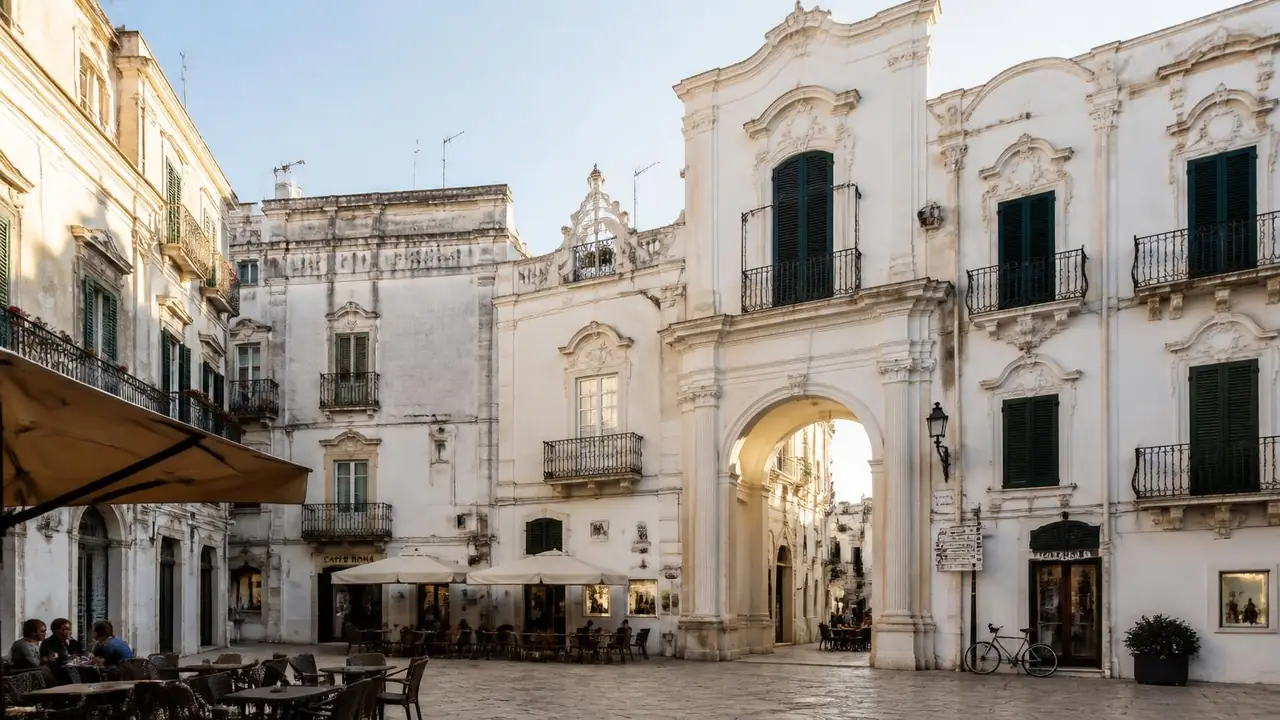
Martina Franca's historic centre sits on a hilltop at the southern edge of Valle d'Itria, built mostly in the Baroque and Rococo styles that spread through the town in the 17th and 18th centuries. The old town holds more than 20 palaces and 15 churches within its walls, according to the regional overview in our best places to visit in Puglia guide — a density that makes it the largest and most architecturally dense of Valle d'Itria's hill towns, ahead of Locorotondo and Alberobello.
Two squares anchor the centre: Piazza Roma, where the Palazzo Ducale stands, and Piazza Plebiscito, dominated by the facade of the Basilica di San Martino. The streets connecting them are narrow and largely traffic-free, lined with whitewashed and pale-stone facades — a different building style from the sloped stone roofs of Locorotondo's cummerse, 7 km away.
Riding or driving in from Locorotondo or Alberobello, Martina Franca reads as a bigger, busier town: more restaurants, a wider choice of accommodation, and streets that stay open into the evening rather than emptying out once the day-trip coaches leave.
Getting around by bike? See our bike rental in Valle d'Itria.
Riding this route on one of our bikes? Start from our bike rental in Puglia — delivery, sizes and prices are all there.
Basilica di San Martino
What it is
Martina Franca's principal church, on Piazza Plebiscito, built between 1747 and 1785 after the earthquake of 20 February 1743 damaged the earlier Romanesque church on the same site. The design is credited to Giovanni Mariani, a Bergamo engineer who had settled in the town and died during construction; decorative work continued under the sculptor Giuseppe Morgese and his sons, according to converging accounts on Wikipedia. Pope John Paul II elevated it to the rank of minor basilica on 22 April 1998.
Why it's worth it
The facade is the reason to stop — about 37 m (121 ft) tall on a 24 m (79 ft) base, in two superimposed orders, with a central sculpted group showing Saint Martin dividing his cloak with a beggar. Locally, it's read as the clearest example of Martinese Rococo, a florid local variant of Baroque decoration.
Practical
Open daily, according to the official basilica website (checked 18 August 2026) — autumn/winter 08:00-12:00 and 16:00-21:00, spring/summer 08:00-23:00. Free entry. Hours can shift around Mass times and religious holidays.
Getting there
On foot, a few minutes from Piazza Roma — the two squares sit at either end of the same stretch of old town.
- Tip: The scale of the facade only really registers from across Piazza Plebiscito — step back rather than standing at the base.
Palazzo Ducale
What it is
The former ducal residence on Piazza Roma, built in 1668 for Petracone V Caracciolo, eighth Duke of Martina Franca, on the site of an earlier medieval castle whose exact construction date isn't consistently recorded across sources. It's now the town hall and one of the main venues of the Festival della Valle d'Itria, covered below.
Why it's worth it
The Baroque facade and internal courtyard are open to the public even outside festival dates, and the building is a working municipio rather than a museum piece — council business happens around whichever rooms are open to visitors.
Practical
Visiting hours and any entry fee for the interior aren't published consistently across official sources at the time of writing — check current hours and pricing when you book, or ask at the tourist office on the day.
Getting there
On Piazza Roma itself, the square that anchors the old town's western side.
- Tip: In late July and early August the courtyard is set up for opera performances — visiting outside those weeks gives a clearer look at the architecture without staging in the way.
Villa Comunale Giuseppe Garibaldi
What it is
Martina Franca's public garden, on the edge of the old town, opened to the public in 1872 after the Comune acquired the land in 1866, following offers to buy it that began in 1861. It covers around a hectare, according to the Regione Puglia's historic gardens portal, giardinidellapuglia.it.
Why it's worth it
Wide, shaded avenues and centuries-old trees, on a layout once known regionally for ars topiaria — hedges and flower beds clipped into shape by the gardeners Alessandro and Alfredo Fighera, father and son, into the 1960s. The topiary work isn't maintained at that level today, but the tree cover and avenue structure remain.
Practical
Free to enter. The garden is fenced and open daily in daylight hours: until midnight from June to September and until 22:00 in April, May and October, according to the Regione Puglia historic gardens portal (checked 19 August 2026). Opening hours change seasonally — check the official site before you go.
Getting there
On foot, a few minutes from the old town centre.
- Tip: The shaded avenues are the most comfortable stretch of the old town to walk through in the early afternoon, when the open streets and squares are at their hottest.
Capocollo di Martina Franca
What it is
A cured pork neck, produced in Martina Franca and two neighbouring municipalities, Cisternino and Locorotondo, at around 400 m of altitude. It is a Slow Food Presidio: the production area, the curing rules and the ban on additives are set out on the official Slow Food Presidio page (checked 19 August 2026), though the page doesn't give a start date for the designation.
Why it's worth it
The curing sets it apart from other Italian capocollo: salted for 15-20 days, washed in cooked grape must, local wine and spices, then wrapped in linen or cotton and smoked over oak and almond wood. Presidio rules ban nitrites and nitrates and require semi-wild pig rearing. It's aged at least 6 months before sale.
Practical
Prices vary by shop, cut and curing time, and we don't have first-hand pricing from a specific Martina Franca producer — ask at the deli counter for current pricing when you're there.
Getting there
Sold at delis and butchers through the old town; ask specifically for Presidio-certified capocollo di Martina Franca, since generic "capocollo martinese" on a supermarket shelf isn't held to the same rules.
- Tip: It's meant for slicing thin and eating at room temperature — not something to carry in a jersey pocket on a hot ride.
Festival della Valle d'Itria
What it is
An annual opera festival founded in 1975, staged mainly in the courtyard of the Palazzo Ducale with additional performances at other historic sites around Valle d'Itria. Since 1980, under artistic director Rodolfo Celletti, it built its reputation on reviving rare and forgotten bel canto opera repertoire rather than staging standard programme works, according to the festival's official history.
Why it's worth it
Hearing opera performed outdoors inside a 17th-century ducal courtyard is a different setting from any conventional opera house, and the programming means you're often seeing a work staged rarely elsewhere.
Practical
The 2026 edition (the 52nd) runs 14 July-2 August, according to the official festival programme (checked 18 August 2026). Ticket prices vary by performance and venue, with no single published price list — check current pricing on the official site when you book.
Getting there
Main performances are in Palazzo Ducale, on Piazza Roma; some events are staged at other Valle d'Itria venues, listed on the official programme.
- Tip: Accommodation in Martina Franca fills up and prices rise during the festival weeks — book well ahead if your visit falls between mid-July and early August.
Seeing Martina Franca by bike
Martina Franca sits at one corner of the same three-town loop covered in our guides to Locorotondo and Alberobello: Martina Franca to Locorotondo is 7 km (4.3 miles), Locorotondo on to Alberobello a further 9 km (5.6 miles), and the road back from Alberobello to Martina Franca another 15 km (9.3 miles) — about 31 km (19 miles) in total, on secondary roads through olive groves and vineyards rather than the SS172 main road.
The terrain is gently rolling rather than flat, with an elevation gain of around 251 m over the loop, mostly as several short rises rather than one long climb, on mostly paved secondary tarmac. Refill water bottles in the main piazza of each of the three towns; there's little in between them.
Starting from Martina Franca rather than Locorotondo changes the order, not the distance: riding anticlockwise (Martina Franca to Alberobello first, 15 km, then Alberobello to Locorotondo, 9 km, then back to Martina Franca, 7 km) covers the same 31 km loop. Either direction, Martina Franca's old town is the busiest and hilliest starting point of the three, so expect a short climb out of town before the road settles onto flatter ground.
Rent the right bike for this route through our bike rental in Valle d'Itria — road or gravel both handle the paved sections fine, and an e-bike takes the edge off the rolling terrain if you're combining all three towns in one day. Martina Franca sits outside our free-delivery area (Lecce, San Foca and Calimera only); delivery here is arranged on request, with the surcharge quoted by distance from our Lecce base rather than a fixed regional price.
Getting to Martina Franca
By car, Martina Franca is around 112 km (70 miles) from Lecce, about 1 hour 25-30 minutes via the SS613 and SP, and around 74 km (46 miles) from Bari, about 1 hour, based on route data checked 18 August 2026 (percorsokm.it and calcolopercorso.it).
Martina Franca station is the terminus of FS Sud Est's Linea 2, the line that runs to Lecce via Francavilla Fontana, as well as a stop on the Bari-Taranto line — so on paper it has a rail link to Lecce that Locorotondo doesn't. In practice, part of that link is currently a bus: the Francavilla Fontana-Lecce section has been closed since 10 June 2024 for electrification and track renewal, with replacement buses covering it, while 18 trains a day still run Martina Franca-Francavilla Fontana, according to the Regione Puglia transport press office. We have found no official announcement that the section has reopened, so plan Lecce-Martina Franca as a train-plus-bus journey and check current timetables and route status on the official FS Sud Est site before you travel, rather than relying on a fixed schedule.
For visitors basing themselves in Lecce or along the Salento coast, Martina Franca is the easiest Valle d'Itria town to reach on public transport, or it works as part of a wider loop paired with Locorotondo, 7 km away, Alberobello, or Ostuni. For the wider regional picture, see our guide to cycling in Puglia.
FAQ
How many days do I need in Martina Franca? Half a day covers the old town — the Basilica di San Martino, Palazzo Ducale and Villa Comunale are all within a few minutes of Piazza Roma. Add a full day if you're combining it with the Locorotondo-Alberobello bike loop.
Is Martina Franca worth visiting for one day? Yes. It's the largest and busiest of Valle d'Itria's hill towns, with more restaurants and accommodation than Locorotondo or Alberobello, and it pairs naturally with either in the same day — both are within 15 km.
What is Martina Franca famous for? Its Baroque old town, the Basilica di San Martino, the Palazzo Ducale, capocollo di Martina Franca (a Slow Food Presidio cured meat) and the Festival della Valle d'Itria, an opera festival held every summer since 1975.
Can I get from Lecce to Martina Franca without a car? Yes, on FS Sud Est's Linea 2 — but expect part of it to be a bus rather than a train. The Francavilla Fontana-Lecce section has been closed for electrification since 10 June 2024 and is covered by replacement buses; trains still run the Martina Franca-Francavilla Fontana half. Check current timetables on the official FS Sud Est site before travelling.
When is the Festival della Valle d'Itria? The 2026 edition runs 14 July-2 August, mainly in the Palazzo Ducale courtyard. Accommodation fills up and prices rise during these weeks — book ahead if your visit falls in that window.
What's the best time of year to visit Martina Franca? April-June and September-October give the mildest weather and quieter streets. Mid-July to early August brings the opera festival and higher prices; November-March is quiet, though some venues reduce their hours.
Explore the Valle d'Itria by bike — request availability. If you're combining Martina Franca with Locorotondo, Alberobello or Ostuni, tell us your route and dates — we'll match you to a bike suited to the rolling terrain and confirm the delivery surcharge for your exact address, since Martina Franca sits outside our free-delivery zone of Lecce, San Foca and Calimera.