
What to See and Do in Locorotondo, the Round Town of Valle d'Itria
By Eugenio TommasiUpdated 18 August 2026 8 min read
Key facts
- Best for
- A circular whitewashed old town, Locorotondo DOC white wine, and views over Valle d'Itria
- Time needed
- Half a day (2-3 hours) for the old town; add a day for the Alberobello-Martina Franca bike loop
- Getting around
- On foot in the old town — everything sits within a few minutes' walk; bike or car to reach Alberobello and Martina Franca
- Indicative cost
- Old town and both churches are free to visit; wine tasting prices vary by cellar, so check current pricing when you book
- Distance from Lecce
- Around 104 km (65 miles), about 1 hour 15-20 by car
- Distance from Bari
- Around 67 km (42 miles), about 55 minutes by car
- When to go
- April-June or September-October — mild weather, quieter streets than midsummer
Locorotondo's circular old town and the cummerse
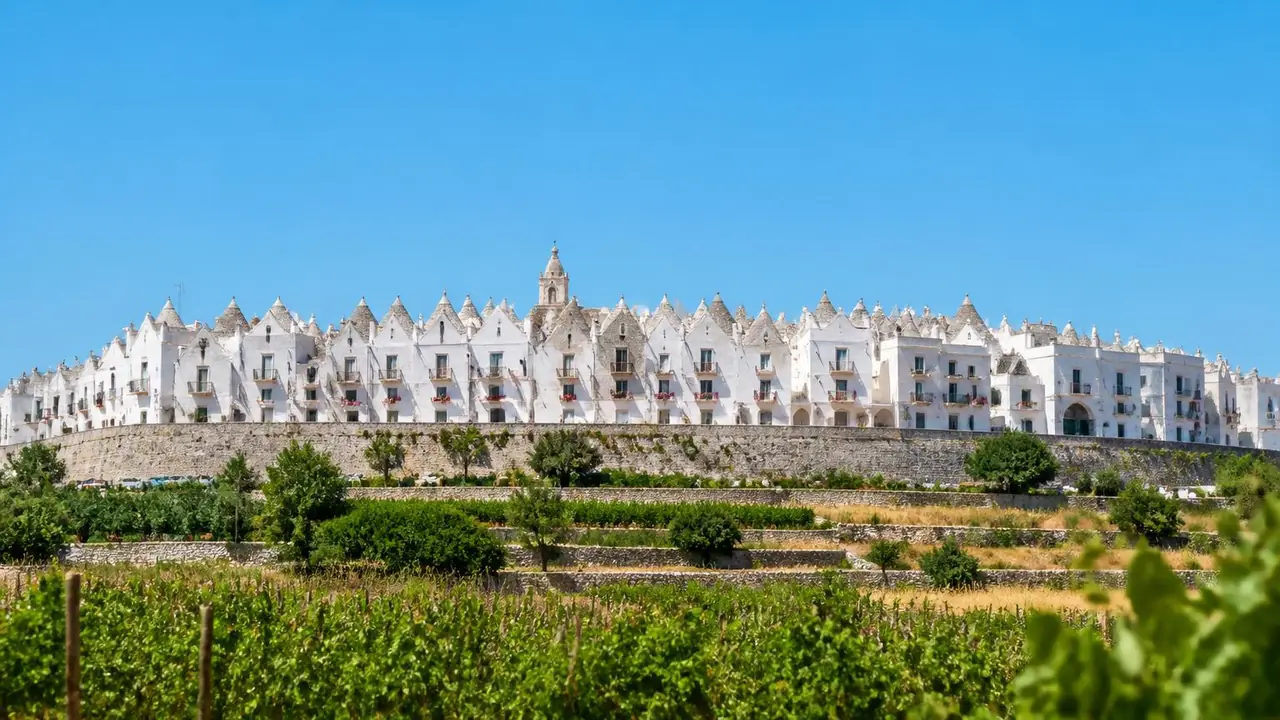
Locorotondo's historic centre is built in a near-perfect circle on a hilltop — the shape the town's name refers to (loco rotondo, "round place") — and it's the only town in Valle d'Itria with this exact layout. The narrow streets radiate and curve around the hill's contour rather than following a grid, so from most points on the outer ring you get a clear view out over the surrounding countryside: vineyards, olive groves and the conical roofs of trulli scattered across the flatter land below.
The building type that makes the old town distinctive is the cummersa (plural cummerse): a narrow, two-storey stone house with a steep double-pitched roof covered in chiancarelle, thin slabs of local limestone. The name comes from the Latin cum vertice, "with a ridge," describing the roof shape. The earliest cummerse are thought to date to the 1300s, built with the same dry-stone technique used for trulli and the region's field walls, though unlike trulli their rectangular plan and steep gable roof look closer to structures found further north in Europe.
Most cummerse are still lived in or run as small shops, bars and guesthouses rather than kept as museum pieces. Walking the full loop of the old town, from Piazza Vittorio Emanuele round the outer streets and back, takes under an hour at an unhurried pace — short enough to combine with the two churches and the Villa Comunale below in a single half-day visit.
Getting around by bike? See our bike rental in Valle d'Itria.
Riding this route on one of our bikes? Start from our bike rental in Puglia — delivery, sizes and prices are all there.
Chiesa Madre di San Giorgio
What it is
The parish church of Locorotondo, dedicated to Saint George, built between 1790 and 1825 in neoclassical style on the site of two earlier churches. It has a Greek-cross floor plan and a dome rising to 35 m (115 ft), according to the official Comune di Locorotondo page.
Why it's worth it
The scale is the surprise — a neoclassical facade with a large pediment and statues of Saint Peter and Saint Paul, standing well above the low roofline of the surrounding cummerse. Inside, paintings by the Neapolitan artist Giuseppe Maldarelli include the Saint George scene on the central apse and an Assumption over the dedicated altar.
Practical
Open daily 07:00-21:30, free entry, according to the official Comune page (checked 18 August 2026). Opening hours can change around religious holidays and services — check before a specific visit.
Getting there
On foot, about 3 minutes from Piazza Vittorio Emanuele, at the entrance to the old town.
- Tip: The dome is visible from several points on the outer ring of the old town before you reach the church itself — a useful landmark for finding your way back to the centre.
Chiesa della Madonna della Greca
What it is
The older of Locorotondo's two main churches. According to the official Comune di Locorotondo page, the first building on the site dates to the 7th-8th century, rebuilt in the 15th century; the earliest documented reference is from 1520. Its three-nave interior, with ribbed cross vaults over the central nave and half-barrel vaults over the side aisles, follows a style typical of 12th-13th century Apulian churches — which is why some sources describe it more loosely as "12th-century."
Why it's worth it
It's a plainer, older counterpart to the Chiesa Madre — sober stone rather than neoclassical decoration, with a fragment of a fresco of the Madonna and Child on the central nave wall, and a stone rose window added in the 20th century by the local craftsman Domenico Rosato.
Practical
Open daily 09:00-21:00, free entry, according to the official Comune page (checked 18 August 2026). Steps at the entrance — no step-free access confirmed.
Getting there
On foot, about 6 minutes from Piazza Vittorio Emanuele, at the edge of the old town centre.
- Tip: Visit both churches back to back — they're a 5-minute walk apart, and seeing them in sequence makes the contrast in age and style easier to place than reading about it separately.
Villa Comunale Giuseppe Garibaldi
What it is
Locorotondo's public garden, laid out in a semicircular plan on the south-west edge of the hill the old town sits on, at the entrance to the historic centre near Piazzetta Vittorio Emanuele. Part of the garden sits on a raised terrace about 6 m (20 ft) above the slope below, according to the Regione Puglia's historic gardens portal, giardinidellapuglia.it.
Why it's worth it
This is the widest view over Valle d'Itria you get without leaving the old town on foot — vineyards and olive groves stretching out from the base of the hill, with Alberobello's trulli-dotted countryside visible on a clear day. It's also where locals meet in the early evening, not just a viewpoint for visitors.
Practical
Free to enter, and open every day, 24 hours a day — there's no gate closing time, according to the Regione Puglia historic gardens portal (checked 19 August 2026).
Getting there
On foot, about 1 minute from Piazza Vittorio Emanuele — it's the first thing you reach at the old town's main entrance.
- Tip: Late afternoon light works better here than midday for photographing the view — the valley faces roughly south-west from the terrace.
Locorotondo DOC: wine tastings in town
What it is
Locorotondo DOC is the white wine denomination named after the town, produced across Locorotondo, Cisternino and part of Fasano's municipal territory. The official production rules published by Regione Puglia set a minimum blend of 50% Verdeca and 35% Bianco d'Alessano grapes, both varieties native to this part of Puglia, with up to 15% other authorised white varieties. The denomination was recognised in 1973.
Why it's worth it
It's a dry, pale straw-yellow wine with greenish reflections — light and mineral, built for the local white-meat and seafood cooking rather than long ageing. Several cellars and wine bars in and around the old town pour it by the glass or run tastings, a practical way to taste a wine that rarely travels far outside the region.
Practical
Tastings are generally arranged directly with individual cellars and wine bars rather than through a single central booking point; opening hours and tasting prices vary by producer, so confirm before you visit.
Getting there
Wine bars and cellar-door tastings are scattered through the old town and the surrounding countryside; ask at your accommodation for a current recommendation, since opening days vary by producer.
- Tip: If you're riding the Alberobello loop below, carry an empty water bottle rather than plan on drinking wine mid-ride — save the tasting for before or after you're back on the bike.
Seeing Locorotondo by bike
Locorotondo sits at the natural midpoint of Valle d'Itria's closest three towns, which makes a loop through all of them a realistic day ride rather than a stretch. From Locorotondo, Alberobello is 9 km (5.6 miles) away, Martina Franca a further 15 km (9.3 miles) from Alberobello, and the road back from Martina Franca to Locorotondo another 7 km (4.3 miles) — about 31 km (19 miles) in total, on secondary roads through olive groves, vineyards and dry-stone field walls rather than the SS172 main road.
The terrain is gently rolling rather than flat: a routed course of the loop shows a total elevation gain of 251 m, mostly as several short rises rather than one long climb, on mostly paved secondary tarmac. Refill water bottles in the main piazza of each of the three towns; there's little in between them.
Rent the right bike for this route through our bike rental in Valle d'Itria — road or gravel both handle the paved sections fine, and an e-bike takes the edge off the rolling terrain if you're combining all three towns in one day. Locorotondo sits outside our free-delivery area (Lecce, San Foca and Calimera only); delivery here is arranged on request, with the surcharge quoted by distance from our Lecce base rather than a fixed regional price.
Getting to Locorotondo
By car, Locorotondo is around 104 km (65 miles) from Lecce, about 1 hour 15-20 minutes via the SS613 and SP toward Martina Franca, and around 67 km (42 miles) from Bari, about 55 minutes. There's no direct train from Lecce: Locorotondo does have its own station, on the Bari-Taranto line run by FS Sud Est (formerly Ferrovie del Sud Est), but reaching it from Lecce means at least one change. Part of the journey is currently by bus rather than train: the Francavilla Fontana-Lecce section has been closed for electrification and track renewal since 10 June 2024, with replacement buses in its place, according to the Regione Puglia transport press office. The works are ongoing, so the route may have reopened to trains by the time you travel — check current timetables on the official FS Sud Est site rather than relying on a fixed schedule.
For visitors basing themselves in Lecce or along the Salento coast, Locorotondo works better as part of a Valle d'Itria loop than as a single-town day trip from that far south — pairing it with Alberobello, 9 km away, Martina Franca, 7 km away, or with Ostuni, makes better use of the drive or ride. For the wider regional picture, see our guide to cycling in Puglia.
FAQ
How many days do I need in Locorotondo? Half a day covers the old town — the two churches, the Villa Comunale and a wine tasting are all within a few minutes' walk of each other. Add a full day if you're combining it with the Alberobello-Martina Franca bike loop.
Is Locorotondo worth visiting for one day? Yes, for the old town alone, and it pairs naturally with Alberobello (9 km away) or Martina Franca (7 km away) in the same day. Streets are quieter than Alberobello's, with fewer coach groups.
What is Locorotondo famous for? Its circular old town layout, the cummerse — narrow gable-roofed stone houses unique to the town — and Locorotondo DOC, a dry white wine made mainly from Verdeca and Bianco d'Alessano grapes grown around the town.
Is Locorotondo's centre walkable, and where do you park? Yes — the old town is compact, walkable in under an hour, and the main sights sit within a few minutes of Piazza Vittorio Emanuele. Car parks ring the edge of the historic centre; check current signage and pricing on arrival, since zones and rates change.
How do I get from Lecce to Locorotondo without a car? By regional service via FS Sud Est (formerly Ferrovie del Sud Est), with at least one change — there's no direct Lecce-Locorotondo train. Part of the route is currently covered by replacement buses while the Francavilla Fontana-Lecce section is being electrified, so check current timetables on the official FS Sud Est site before travelling.
What's the best time of year to visit Locorotondo? April-June and September-October give the mildest weather and quieter streets. July-August is hot and busier around midday; November-March is quiet, though some venues reduce their hours.
Ride the Valle d'Itria — book your bike now. If you're combining Locorotondo with Alberobello, Martina Franca or Ostuni, tell us your route and dates — we'll match you to a bike suited to the rolling terrain and confirm the delivery surcharge for your exact address, since Locorotondo sits outside our free-delivery zone of Lecce, San Foca and Calimera.