
What to See and Do in Gallipoli, Salento's Island Old Town
By Eugenio TommasiUpdated 19 August 2026 9 min read
Key facts
- Best for
- An island old town encircled by 16th-century walls, a Baroque cathedral, and a free beach inside the historic centre
- Time needed
- Half a day for the old town, castle and cathedral; a full day with Baia Verde or a ride down the coast
- Getting around
- On foot inside the old town; bike or car for Baia Verde and the coast further south
- Indicative cost
- Castello Angioino entry is paid; check current pricing when you book, since no price is published on the castle's official ticketing platform or by the Comune di Gallipoli. The Concattedrale di Sant'Agata publishes no admission charge
- Distance from Lecce
- 39 km (24 miles), about 40-45 minutes by car, or a flat 2-hour ride by bike at a relaxed pace
- Distance from Bari
- 193 km (120 miles) by road, about 2 hours 35 minutes by car — verified 19 August 2026 on two independent OSRM routing servers
- Distance from Brindisi Airport
- 88 km (55 miles) by road, about 1 hour 20 minutes by car — verified 19 August 2026 on two independent OSRM routing servers
- When to go
- April-June and September-October for mild weather and quieter streets; swimming season runs roughly June-September
Gallipoli's old town: what to see first
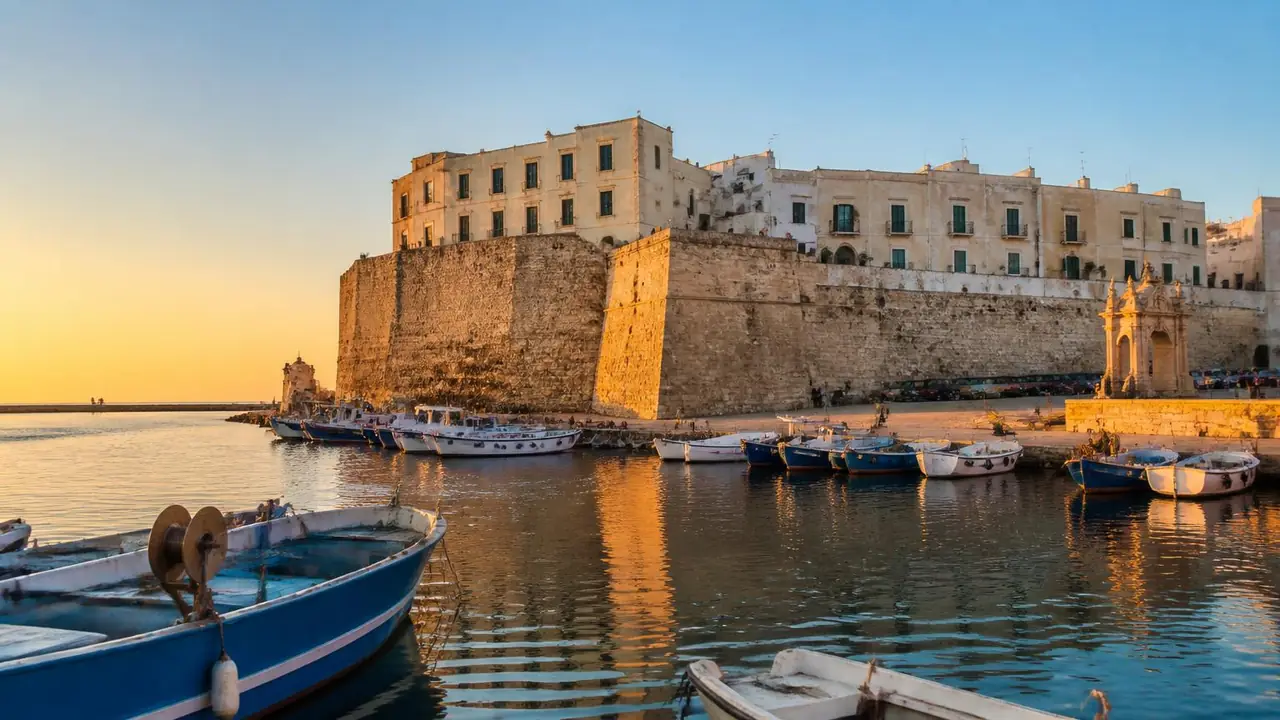
Gallipoli's historic centre sits on a small island on Salento's Ionian coast, ringed by roughly 1.5 km (0.9 miles) of walls and connected to the newer part of town by a single bridge. Venice cut the original isthmus in 1484, when Gallipoli came under Venetian control, to make the borough easier to defend; the current bridge, with its 12 arches, was designed in 1601 and built between 1603 and 1607, replacing an earlier drawbridge. Everything below sits inside or right at the edge of that walled island.
The old town is flat and compact, built from pale local stone (carparo), with narrow lanes that open onto the sea on three sides. Cars and bikes generally stay outside the walls; once across the bridge, it's a place to walk. Gallipoli is 39 km (24 miles) from Lecce by road, flat the whole way — see Seeing Gallipoli by bike below for how that ride, and the coast further south, actually work.
Riding this route on one of our bikes? Start from our bike rental in Gallipoli — delivery, sizes and prices are all there.
The historic centre, sight by sight
Castello Angioino and the Rivellino
What it is
a quadrangular castle with four cylindrical corner towers, its core built by the Angevins in the 13th century over earlier Byzantine-era defences, according to the Comune di Gallipoli. A fifth tower, the Rivellino, stands detached in the water in front of the main structure, completed in 1522 as an advanced outpost controlling the approach to the bridge. Local historical accounts attribute its design to the Sienese military architect Francesco di Giorgio Martini, recorded as visiting Gallipoli in 1491-92, though we haven't traced this to a primary source.
Why it's worth it
it's a working defensive complex rather than a single tower — the Rivellino is a separate structure, isolated by water, built specifically to protect the bridge crossing rather than as decoration.
Practical
opening hours currently follow the exhibition programme. During the show running at time of writing ("Visioni Mediterranee — Opere di Renato Guttuso"), the castle is open 10:00-13:00 and 16:30-22:30 through September 2026 (closed on 19 September), shortening to 10:00-13:00 and 15:00-20:00 for the first half of October, with the ticket office closing 30 minutes before, per liveticket.it (the official ticketing platform, verified 19 August 2026). No ticket price is published there, on the Comune di Gallipoli's pages, or on the castle's own site, which we could not reach — check current pricing when you book. Opening hours change seasonally — check the official site before you go.
Getting there
at the edge of the old town, right by the bridge — a couple of minutes on foot from anywhere in the historic centre. No bike or car access inside the pedestrian area; lock bikes near the bridge.
- First-hand tip: hours shift with each exhibition, exactly as at Otranto's castle further up the coast — check the current programme before building a visit around it.
The old town and the Ponte Seicentesco
What it is
the walled island itself, its lanes and whitewashed houses connected to the mainland only by the 17th-century bridge described above.
Why it's worth it
it's a small enough area to cover on foot in a couple of hours, with the sea visible from most streets and three different waterfronts within a short walk of each other.
Practical
free and open at any time; some streets are pedestrian-only, others allow limited resident traffic.
Getting there
the bridge is the only land route in — reached on foot in a few minutes from any car park or bike parking point on the mainland side.
- First-hand tip: the bridge itself is worth a slow crossing rather than a quick pass-through — it's the clearest vantage point for the castle, the Rivellino and the old town walls together in one view.
Cattedrale di Sant'Agata
What it is
the town's Baroque cathedral, built between 1629 and 1696 on the site of an earlier medieval church, described by the Comune di Gallipoli as the most representative Baroque monument in Gallipoli. The interior follows a Latin cross plan with three naves divided by Doric columns, and holds paintings by Giovanni Andrea Coppola and Nicola Malinconico.
Why it's worth it
the concentration of 17th-century Baroque paintings inside a single building gives a compact sense of the period, without needing to move between several churches.
Practical
address Via Duomo 1. The parish's own site, cattedralegallipoli.it, publishes Mass times rather than visiting hours: on the summer schedule, weekdays at 19:00 and Sundays at 10:00 and 19:00 (verified 19 August 2026). No separate visitor opening hours and no admission charge are published by the parish or by the Diocesi di Nardò-Gallipoli, so hours and prices can change — confirm before you visit.
Getting there
on foot, a few minutes from the bridge, roughly in the middle of the old town.
- First-hand tip: as a working parish co-cathedral rather than a museum, visiting hours tighten around Mass times — a mid-morning or mid-afternoon visit avoids the risk of finding a service in progress.
Fontana Greca
What it is
a stone fountain with two carved facades of about 5 m each, standing beside the old bridge where the historic centre meets the newer part of town. One facade shows Gallipoli's coat of arms — a rooster with the Latin inscription "fideliter excubat" ("it watches faithfully") — and the other shows bas-reliefs of three mythological figures transformed into springs: Dirce, Salmace and Biblide.
Why it's worth it
local tradition dates it to the 3rd century BC, which would make it one of the oldest fountains in Italy, but later architectural scholarship — the studies of art historian Bernich, cited in local historical accounts — argues for a Renaissance-era construction instead. Both accounts are still in circulation, and no single dating has settled the question.
Practical
outdoor, free, visible at any time. The fountain has also been moved at least twice in its documented history — to a site near the Chiesa di San Nicola in 1548, and again in 1560 — before settling at its current position.
Getting there
right beside the bridge, at the edge of the old town — the same spot as the castle and Rivellino above.
- First-hand tip: walk around to both facades — most visitors only see the side facing the road, and the mythological bas-reliefs on the other side are easy to miss.
Spiaggia della Purità
What it is
a small cove beach set directly below the old town's bastions, inside the historic centre itself.
Why it's worth it
it's a free, unequipped beach in the middle of a walled old town — an unusual combination on this coast, where most central beaches come with paid concessions. The water is shallow and generally calm, sheltered by the cove.
Practical
free access, no beach clubs or sunbeds; generally open at any time, though we haven't confirmed whether any seasonal access limits apply — check locally if you're visiting outside peak season.
Getting there
on foot, a few minutes from the cathedral or the bridge, tucked against the old town walls.
- First-hand tip: it's genuinely small — space fills up fast from mid-morning in July and August. For more room, Baia Verde south of town, covered next, is the better choice for a full beach day.
Beyond the walls: beaches and the coast south
Baia Verde
What it is
a stretch of sandy beach on the Ionian coast south of the old town, with several beach clubs along it.
Why it's worth it
it's a proper sand beach rather than a cove, with calm water protected by the shape of the inlet — a different day out from the compact Spiaggia della Purità inside the walls.
Practical
mixed free and paid-concession sections; specific current pricing for the beach clubs wasn't confirmed on an official source, so check current pricing when you book a sunbed.
Getting there
by bike or car, south along the flat coast road out of the old town — 5.8 km (3.6 miles) to the middle of Baia Verde, verified 19 August 2026 by OSRM routing on OpenStreetMap data, so around 20 minutes at a relaxed pace. The northern end of the beach is nearer.
- First-hand tip: parking fills quickly on summer weekends; arriving by bike avoids the search for a space.
The coast continues south past Punta della Suina toward Torre San Giovanni, in the Ugento area — 31 km (19 miles) by road from Gallipoli, all of it flat along the Ionian shoreline. Further south again, the coast reaches Santa Maria di Leuca at the tip of the peninsula: 48 km (30 miles) from Gallipoli on the direct inland road, or about 61 km (38 miles) if you follow the coast round through Torre San Giovanni. All three figures verified 19 August 2026 by OSRM routing on OpenStreetMap data and cross-checked on a second routing server.
Seeing Gallipoli by bike
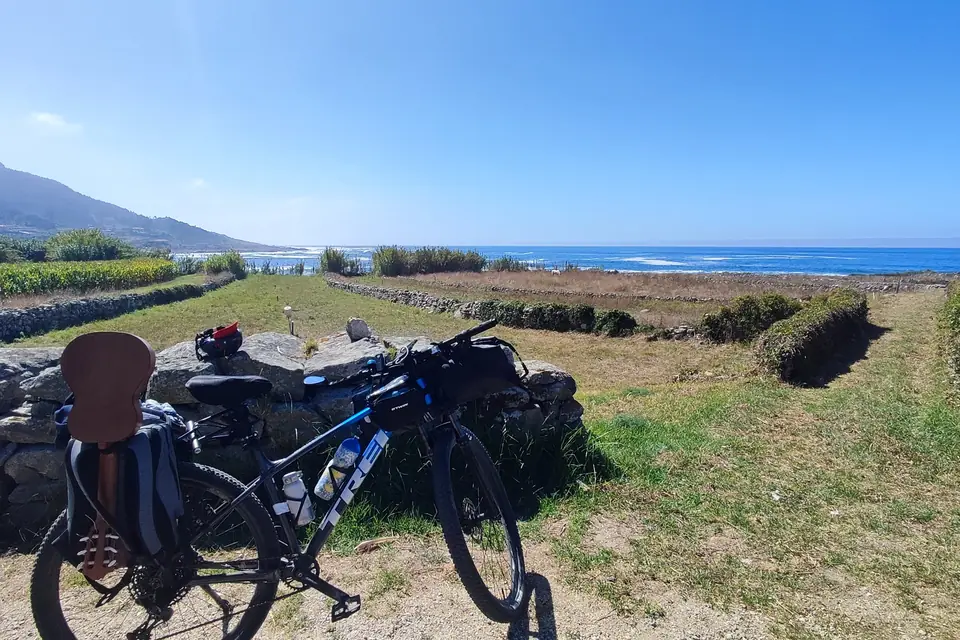
Gallipoli works as a flat ride out from Lecce and as the starting point for exploring the Ionian coast further south.
Getting here: Lecce to Gallipoli is 39 km (24 miles), flat for almost the entire distance, around 2 hours at a relaxed pace on a road or gravel bike — the same route and distance we quote on our Lecce rental page. A longer, more scenic alternative runs via Leverano, Porto Cesareo and Santa Caterina: 57.9 km (36 miles) with 152 m (499 ft) of climbing, 81% paved and 3% gravel, mostly on quiet roads, per Bikemap (verified 18 August 2026) — worth the extra distance if Porto Cesareo's coastline is part of the day.
Riding on from Gallipoli: south of the old town, the coast road runs flat to Baia Verde (5.8 km / 3.6 miles) and continues past Punta della Suina toward Torre San Giovanni in the Ugento area, 31 km (19 miles) one way — both figures verified 19 August 2026 by OSRM routing on OpenStreetMap data. We haven't ridden this specific stretch ourselves to confirm current road surface conditions or measure it on our own track, since it isn't a route we cover regularly from our Lecce base — treat this as a planning estimate rather than a route we've ridden and mapped ourselves, and check conditions locally before committing a group to it.
Fill water bottles in Gallipoli's old town before heading south — services thin out quickly past Baia Verde outside the main summer season. An e-bike is worth considering for the return leg into any headwind off the Ionian, which this stretch of coast gets regularly.
Rent the right bike for either direction through bike rental in Lecce & Salento — road or gravel for the ride down from Lecce, e-bike if you're planning to continue south toward Torre San Giovanni and back in a day. For the wider picture of where else you can ride in the region, see cycling in Puglia.
How much time do you need in Gallipoli?
| Time available | What you can realistically cover |
|---|---|
| 2-3 hours | The old town on foot: the bridge, Castello Angioino and Rivellino, Fontana Greca, a walk through the lanes to the cathedral |
| Half a day | The above, plus Spiaggia della Purità and a slower look inside the cathedral |
| Full day | Old town and castle, plus a ride or drive to Baia Verde, or further south toward Punta della Suina and Torre San Giovanni |
Gallipoli pairs naturally with the rest of the Salento coast on a longer trip — see our Salento travel guide for how it fits alongside Lecce, Otranto and Santa Maria di Leuca, and the best places to visit in Puglia for how Salento compares with the rest of the region.
Getting to Gallipoli without a car
Gallipoli has its own station on the Ferrovie del Sud Est network, served by FSE line 5, Lecce-Gallipoli — a direct line, no change required, unlike the Otranto connection, which runs on the separate Maglie-Otranto branch. Check current timetables on the official FS Sud Est site before travelling, since regional schedules change seasonally. The station sits about 1 km from the old town.
By road, Gallipoli is 39 km (24 miles) from Lecce and 88 km (55 miles) from Brindisi Airport, about 1 hour 20 minutes by car, verified 19 August 2026 by OSRM routing on OpenStreetMap data and cross-checked on a second routing server. Allow more in July and August. If you're arriving by bike from Lecce instead, see Seeing Gallipoli by bike above.
FAQ
What is the best time of year to visit Gallipoli? April-June and September-October give mild weather and quieter streets. July-August is busy and hot, with the old town and beaches at their fullest; swimming season runs roughly June to September.
Is Gallipoli's old town suitable for wheelchairs or pushchairs? The old town itself is flat, since it sits on a low island, though streets are narrow and some are cobbled. We haven't verified step-free access at specific sites such as the cathedral or castle, so check ahead directly with the venue if step-free access is essential for your visit.
Can I visit Gallipoli without a car? Yes — Gallipoli has its own station on the Ferrovie del Sud Est network, with a direct line from Lecce and no change required. The old town, bridge and Spiaggia della Purità are all within walking distance of each other once you're there.
Is there parking near Gallipoli's old town? The historic island is largely pedestrian, so cars park on the mainland side near the bridge. We haven't verified current paid or free parking zones from an official source, so check local signage on arrival.
Is Gallipoli suitable for a family visit with children? The old town is flat and compact, and Spiaggia della Purità sits inside walking distance of the centre, which makes a family day manageable without much driving. Baia Verde, a short ride south, is a better choice for a full beach day with more space.
How does Gallipoli compare to Otranto or Lecce? Gallipoli is a walled old town on a small island on Salento's Ionian coast; Otranto is a similarly compact walled port town on the Adriatic side; Lecce, our home base, is a larger Baroque city inland. See our Salento travel guide for how the three fit into one trip.
Explore the Ionian coast by bike. Rent a road, gravel or e-bike from our base in Lecce, 39 km away, and ride out to Gallipoli on flat roads — or tell us your dates and we'll quote delivery to Gallipoli directly. For the coast road south toward Baia Verde and Torre San Giovanni, an e-bike takes the edge off any headwind on the way back.