
What to See and Do in Brindisi, Puglia's Port City
By Eugenio TommasiUpdated 18 August 2026 10 min read
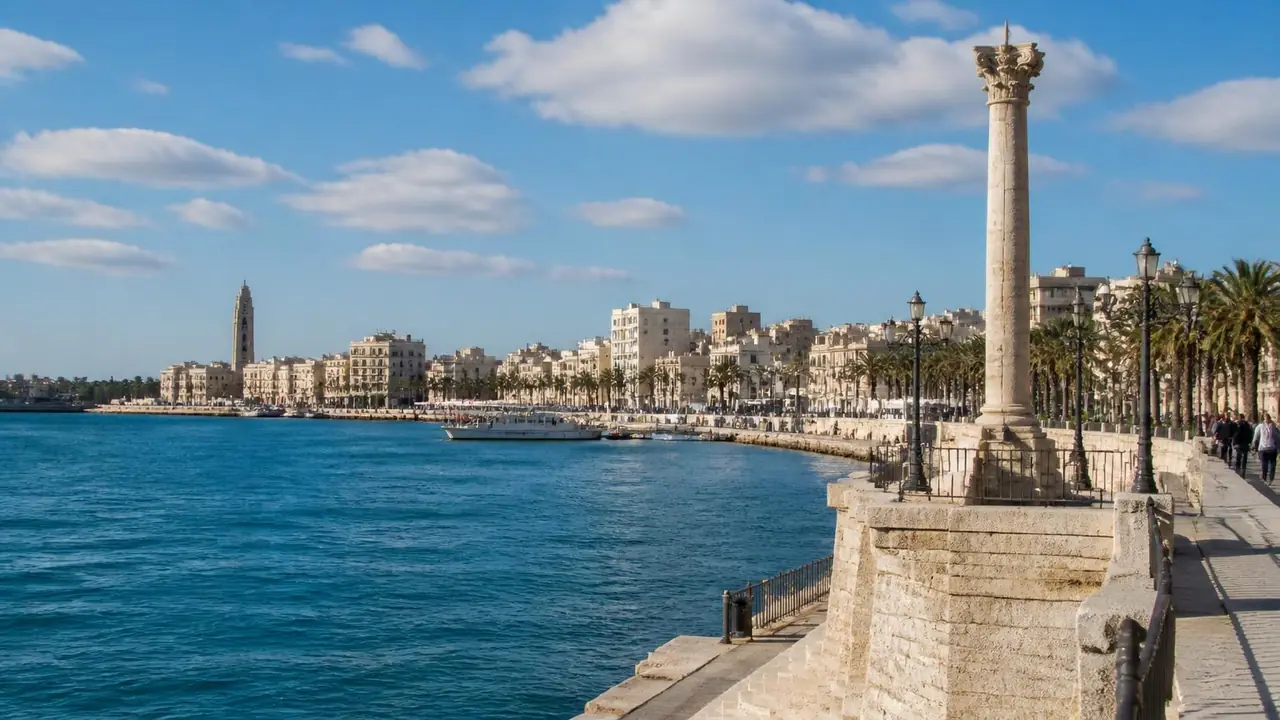
Key facts
- Best for
- A compact old town built around a working harbour — Roman columns, a Baroque cathedral and a fortress on an island, rather than a beach or countryside destination
- Time needed
- 2-3 hours for Piazza Duomo, the museum and the Colonne Romane; half a day with the Castello Alfonsino boat trip or the Monumento al Marinaio
- Getting around
- On foot in the old town; a short ferry crossing for the Monumento al Marinaio; bike or car for Santa Maria del Casale and the airport
- Indicative cost
- Old town and Colonne Romane free; Museo Archeologico free; Monumento al Marinaio €3 adults; Castello Alfonsino €8 (guided tour, booking required)
- Distance from Lecce
- 40 km (25 miles), about 35 minutes by car; regional trains run the same route — check current times on Trenitalia
- Distance from Bari
- 115 km (71 miles), about 1 hour 30 by car
Brindisi's port and old town: what to expect
Brindisi is mainly known as a gateway — its airport, Aeroporto del Salento (BDS), is how most visitors reach this part of Puglia, and its port has handled ferries toward Greece and Albania for decades. It isn't a primary sightseeing destination the way Lecce or Ostuni are, and this guide won't pretend otherwise: most people who read this are either landing here on their way to Salento, or have a few hours between a flight and a ferry.
That said, the old town has genuine history behind the transit hub. Brindisi's natural double harbour — an inner and outer basin, protected from the open Adriatic — is why the Romans made this the eastern terminus of the Via Appia, the road from Rome, and why the city stayed strategically important through the Norman, Swabian and Aragonese periods that followed. The compact centre sits on a promontory between the two harbour basins, walkable in under half an hour end to end.
If you're spending a night here rather than passing straight through, the sights below cover a realistic two to three hours on foot, extendable to a half day if you add the boat trip to Castello Alfonsino or the ferry across to the Monumento al Marinaio.
Riding this route on one of our bikes? Start from our bike hire in Puglia — delivery, sizes and prices are all there.
The historic centre, sight by sight
Piazza Duomo and the Cattedrale di Brindisi
What it is
the old town's main square and the Basilica Cattedrale della Visitazione e San Giovanni Battista, consecrated by Pope Urban II in 1089 and completed in 1143.
Why it's worth it
what survives from the Romanesque original is limited — some mosaic flooring and a carved cornice on the right apse — because the cathedral was badly damaged in the earthquake of 20-21 February 1743 and rebuilt by the Lecce architect Mauro Manieri, completed in 1750. The building on the square today is mostly the 18th-century reconstruction, despite the 11th-century founding date.
Practical
the square is open and free at all times. The cathedral itself is open to visitors daily, 08:30-12:30 and 16:30-20:30, with no entry charge; tourist visits are suspended during liturgical services, and covered shoulders and knees are required. Verified via the basilica's own site, cattedralebrindisi.it, August 2026. Opening hours change seasonally — check the official site before you go.
Getting there
the natural centre of the old town, a few minutes' walk up from the harbour.
Practical note
the Museo Archeologico Provinciale sits on the same square, so the two combine without extra walking — see below.
Museo Archeologico Provinciale "Francesco Ribezzo"
What it is
Brindisi's civic archaeological museum, on Piazza Duomo, founded in 1884 to house material from local excavations. Six sections cover epigraphy, statuary, an antiquarium, prehistoric finds, coins, and the bronzes recovered off Punta del Serrone.
Why it's worth it
the statuary section holds Roman-era pieces excavated directly from the streets and squares of the old town — the physical evidence behind the Roman city implied by the Colonne Romane below.
Practical
open Tuesday-Sunday, 09:00-19:15, closed Monday; free entry; groups must book ahead on +39 0831 544257, with a maximum of 25 people per group. Address: Piazza Duomo. Verified via comune.brindisi.it, August 2026. Opening hours change seasonally — check the official site before you go.
Getting there
on the same square as the cathedral.
Practical note
a third-party listings site quotes a €5 ticket price for this museum — the Comune di Brindisi's own page states free entry, and that's the figure used here.
Scalinata Virgiliana and the Colonne Romane
What it is
a wide staircase linking the upper old town to the harbour, with two Roman columns standing at its base — the traditional marker of the end of the Via Appia, the road that connected Rome to its main Adriatic port.
Why it's worth it
only one column stands complete today. The other collapsed on 20 November 1528; its pieces lay on the ground for over a century until Brindisi gifted them to Lecce in 1657, in gratitude after Lecce was spared during a plague outbreak that struck the rest of the kingdom. In 1666, the sculptor Giuseppe Zimbalo used that marble to raise the column that still stands in Lecce's Piazza Sant'Oronzo — the same column covered in our things to do in Lecce guide. It's a direct physical link between the two cities' main squares, rarely mentioned in general guides to either city.
Practical
freely visible at any time, no ticket required.
Getting there
at the top of the steps down to the harbour, a short walk from Piazza Duomo.
Practical note
this is also the departure point for the boat to Castello Alfonsino, below — worth combining in one stop rather than two separate trips.
Castello Alfonsino (Forte a Mare)
What it is
a red-brick fortress on the small island of Sant'Andrea, at the mouth of Brindisi's outer harbour, reachable only by boat. It's distinct from Brindisi's other castle, the Castello Svevo (Castello di Terra) on the mainland, which is a working Marina Militare base and opens to the public one weekend a month — Saturday and Sunday, free, with compulsory booking on pastpuglia.it, groups capped at 40 and photo ID required. Worth knowing before you plan around "the castle" in Brindisi, since guides rarely distinguish the two.
Why it's worth it
it's one of the few points in Brindisi where the harbour's full shape is visible from outside it — the natural double basin that made this one of the more defensible ports on the Adriatic, and the reason the Roman road ended here rather than further along the coast.
Practical
access is by guided tour only, with shifts that change month to month — 10:30, 18:00 and 19:15 in July 2026, and 10:30, 17:30 and 18:15 in August 2026. Tours run about 50 minutes. €8, reduced to €6 for residents of Brindisi and its province with valid ID, free under 6. Booking is compulsory via pastpuglia.it or the PastPuglia app, or by phone on 379 265322 between 10:00-12:00 and 16:00-18:00. Verified August 2026 via pastpuglia.it, which runs visits under a valorisation agreement with the Ministry of Culture's Soprintendenza for Brindisi, Lecce and Taranto. Opening hours change seasonally — check the official site before you go.
Getting there
by boat, departing from near the Scalinata Virgiliana. No bike or car access.
Practical note
book at least a couple of days ahead in summer — shifts are capped and this isn't a walk-up site.
Monumento al Marinaio d'Italia
What it is
a 54 m (177 ft) helm-shaped monument on the Casale side of the harbour, inaugurated on 4 November 1933, commemorating sailors of the Navy and Merchant Marine lost at sea. A crypt at its base holds black marble plaques recording 6,850 names, from 1860 onward.
Why it's worth it
the interior is open to climb, and the view from the top takes in the whole inner harbour and old town from across the water — a wider angle than anything available from the Brindisi side itself.
Practical
monument open 10:00-16:40, closed Wednesday; the crypt keeps separate hours, 08:00-16:00, closed Wednesday and Thursday. Adults €3, ages 11-18 €1, groups of 25 or more €2 each, free for Brindisi residents and under-10s, combined ticket with the Tempietto di San Giovanni al Sepolcro €5. Address: Via Ammiraglio Millo 2. Verified via comune.brindisi.it, August 2026. Opening hours change seasonally — check the official site before you go.
Getting there
by the small ferry crossing the inner harbour from the Brindisi side. This is the STP motobarca, run as a scheduled line of Brindisi's urban transport network between the Centro and Casale sides, so it takes the same ticket as an STP bus rather than a separate fare. STP publishes the timetable as a downloadable PDF on stpbrindisi.it — check current times before planning a visit around the crossing, and confirm directly with STP whether bikes are allowed on board, since that isn't stated on the published timetable.
Practical note
combine with the Chiesa di Santa Maria del Casale below — both sit on the Casale side of town, away from the old town centre.
Chiesa di Santa Maria del Casale
What it is
a Romanesque-Gothic church about 2.5 km (1.5 miles) north of Piazza Duomo by bike, on the road toward the airport, built between 1284 and 1322. Declared a national monument in 1875.
Why it's worth it
the interior holds a Last Judgment fresco cycle across the back wall, painted by Rinaldo da Taranto in the early 14th century — one of the more complete fresco cycles surviving in Puglia from this period, well above what the church's roadside location suggests.
Practical
opening hours to the public aren't published on a parish, diocesan or municipal source we could find — the times circulating online come only from third-party listings sites, so we're not repeating them here. Confirm current opening hours locally before you go, for example by calling ahead. Address: Via Ruggero de Simone.
Getting there
about 2.5 km north of Piazza Duomo by bike, or roughly 4 km by car, which follows a longer one-way loop out of the centre. It sits on the way to the airport, a realistic stop if you're cycling to or from Brindisi Airport — covered in the bike section below.
Practical note
this is the one sight in this list that sits directly on the route between the city and the airport, which makes it worth timing around a flight rather than a dedicated trip.
Getting to and around Brindisi
By car, Brindisi is about 40 km (25 miles) from Lecce, roughly 35 minutes via the SS613. Regional trains run more frequently: Brindisi sits on the line linking Bari, Monopoli, Ostuni, Brindisi and Lecce. We're not quoting a journey time here — Trenitalia doesn't publish a fixed figure for the leg and regional services change with the timetable, so check current timetables on Trenitalia's official site before you travel. From Bari, allow about 1 hour 30 by car for the 115 km (71 miles).
Brindisi's airport, Aeroporto del Salento (Papola Casale, BDS), sits about 5 km (3 miles) north of Piazza Duomo by road, and about 3.5 km from the railway station. There's no direct train between the airport and other Salento towns, but Trenitalia sells a combined train-and-bus ticket — the "Air&Port Link" — that connects Brindisi's main railway station to the airport in about 15 minutes; the bus leg is run by STP Brindisi and adds €1.20 to the train fare, with no discounts applicable to it. Select "Brindisi Aeroporto" as your destination when booking on Trenitalia's site. STP Brindisi also runs the same shuttle as a standalone bus, a circular line linking the airport, the railway station and the Costa Morena port every 30 minutes from 05:00 to 00:15; between 05:00-07:45 and 21:15-00:15 it serves the airport and the railway station only. Airport to the city centre takes 10-15 minutes and a single ticket costs €1.10. Verified via STP Brindisi's official page, August 2026 — check the current timetable before you fly.
Once in the old town, everything covered above is within walking distance except the Monumento al Marinaio, which needs the harbour ferry, and Santa Maria del Casale, which is a short ride or drive north.
Seeing Brindisi by bike
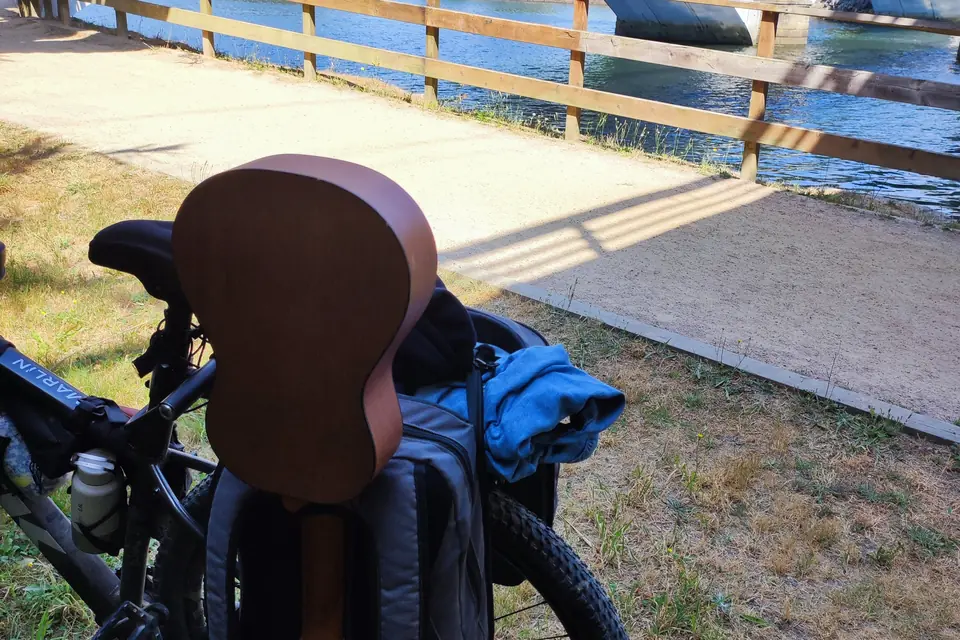
Brindisi isn't a cycling destination in the way Salento's coast or Valle d'Itria are — there's no loop here we'd send a group out on for a full day. What it does offer is a short, flat ride that makes sense if you're arriving by air or ferry and have a few hours before your onward journey.
Route: Piazza Duomo to Chiesa di Santa Maria del Casale (out and back)
| Detail | Value |
|---|---|
| Distance one way | About 2.7 km (1.7 miles) if you drop down to the Lungomare Regina Margherita, the harbourside promenade, before turning north out of town to the church; about 2.4 km if you ride straight there |
| Distance round trip | About 5.5 km (3.4 miles) |
| Elevation | Flat — Brindisi's old town and harbour sit at or near sea level throughout this route |
| Surface | Paved road and promenade the whole way |
| Water | Fill bottles at a bar on Piazza Duomo before setting off — nothing reliable between the promenade and the church |
| Time | 20-30 minutes at an easy pace, plus time at the church |
Distances above are road distances from OpenStreetMap cycling routing, checked August 2026, not straight-line figures. We haven't ridden this specific route ourselves to check current road conditions, since Brindisi isn't a route we cover regularly from our Lecce base — the elevation figure below comes from an OpenStreetMap-routed GPX track, not a ride we've logged in person. That routing puts elevation gain at about 16 m (52 ft) one way, confirming the route is essentially flat. If you're continuing on to the airport rather than turning back, the terminal is only about 600 m further on from the church.
Riding on toward Lecce and the rest of Salento is possible in distance terms — about 40 km (25 miles) — but we're flagging this as a distance fact, not a recommended ride: the direct road, the SS613, is a fast dual carriageway unsuited to cycling, and we haven't ridden or verified a quieter back-road alternative ourselves — treat this as a planning estimate rather than a route we recommend cycling.
Rent the right bike for a short in-town ride, or for the road ahead once you're past Brindisi, through our bike rental in Puglia. Landing in Brindisi? We deliver your bike to the airport area — it's outside our free-delivery zone of Lecce, San Foca and Calimera, but we quote delivery to the airport or the port for any dates you send us. For where the riding genuinely opens up once you're clear of Brindisi, see our cycling in Puglia guide.
How much time do you need in Brindisi?
| Time available | What you can realistically cover |
|---|---|
| 1-2 hours (stopover) | Piazza Duomo, the Cattedrale and a walk down the Scalinata Virgiliana to see the Colonne Romane |
| 2-3 hours | The above, plus the Museo Archeologico Provinciale |
| Half a day | The above, plus the boat trip to Castello Alfonsino or the ferry to the Monumento al Marinaio |
| Full day | Old town and harbour sights, plus the short bike ride out to Chiesa di Santa Maria del Casale |
Most visitors use Brindisi as a stop on the way to or from Salento rather than a base — for where to spend the extra nights, see the best places to visit in Puglia or our Salento travel guide. Brindisi also sits on the same rail line as Ostuni and Bari, making a day trip in either direction straightforward if you're based here overnight.
FAQ
Is Brindisi worth visiting, or just passing through? For most travellers, Brindisi is a transit point — the airport and port, not a headline destination. If you have two to three hours, the old town around Piazza Duomo and the Colonne Romane is worth the stop; it isn't worth restructuring a longer trip around.
How do I get from Brindisi Airport to the city centre? By STP Brindisi's shuttle bus, a circular line between the airport, the railway station and Costa Morena port, every 30 minutes from 05:00 to 00:15. It takes 10-15 minutes to the centre and a single ticket costs €1.10. If you're continuing onward by train, Trenitalia sells a combined train-and-bus "Air&Port Link" ticket instead, with the bus leg adding €1.20 to the train fare. Check current timetables on the official sites before you fly, since schedules vary by season.
How do I get from Brindisi to Lecce? By car in around 35 minutes for the 40 km (25 miles), or by regional train on the Bari-Lecce line. We aren't quoting a train journey time, since Trenitalia doesn't publish a fixed figure for the leg — check Trenitalia for current timetables.
Is Brindisi a good base for a cycling holiday in Puglia? Not really. Brindisi's old town offers one short, flat ride and little else for cycling — Lecce, Ostuni or the Valle d'Itria towns give you far more road and gravel riding within reach. Brindisi works better as an arrival or departure point than a cycling base.
What's the difference between Brindisi's two castles? Castello Svevo (Castello di Terra) is a working Marina Militare base on the mainland, open to the public only one weekend a month — Saturday and Sunday, free, with compulsory booking. Castello Alfonsino (Forte a Mare) is on the island of Sant'Andrea, reachable by boat, and runs guided tours on set daily shifts with advance booking via pastpuglia.it.
Is there anything worth seeing near Brindisi Airport itself? Yes — the Chiesa di Santa Maria del Casale, about 2.5 km north of Piazza Duomo by bike and only around 600 m short of the terminal, holds a 14th-century Last Judgment fresco cycle. It's realistic to fit in on the way to or from a flight.
Landing in Brindisi? We deliver your bike to the airport area from our Lecce base, 40 km away. It's outside our free-delivery zone of Lecce, San Foca and Calimera, so delivery here is quoted rather than free — tell us your flight or ferry times and we'll work out timing and cost before you book.