
Things to Do in Polignano a Mare: Old Town, Viewpoints and Sea Caves
By Eugenio TommasiUpdated 17 August 2026 9 min read
Key facts
- Best time to visit
- April-June and September-October — mild weather, fewer crowds than July-August
- Time needed
- Half a day for the old town and viewpoints; a full day with the Museo Pino Pascali and lunch
- Getting around
- On foot in the historic centre; regional train or a flat coastal ride to reach Monopoli
- Indicative cost
- Free to walk the centre and viewpoints · Museo Pino Pascali €10 (€6 reduced) · Grotta Palazzese by reservation, price on request
- Distance from Bari
- 35 km (22 miles) by road; about 25 minutes by direct regional train
- Distance from Lecce (our base)
- around 117 km (73 miles) by road, about 1 hour 30 by car; direct regional trains run from Lecce in about 1 hour 20, and several other services need a change at Bari
Walking Polignano a Mare's historic centre
The old town was originally enclosed by a defensive wall and a moat, reinforced during the period of Venetian influence in the 16th century. A stretch of the original wall is still visible above Piazza Garibaldi, absorbed into the later Marquis' Palace, and a watchtower survives near the sea on the eastern side of Lama Monachile — the last piece of an angular fortification system that once ringed the town.
The Marquis' Arch, also known as the Great Door, was the main entrance to the village until 1780, when the town began expanding beyond its original walls. Streets inside the old walls are narrow, mostly pedestrian and largely traffic-free, which makes the centre easy to cover on foot but less straightforward with a pushchair or wheelchair — several lanes have steps, and the clifftop setting means uneven ground in places.
Palazzo dell'Orologio (Clock Palace)
What it is
The former town hall, standing in Piazza Vittorio Emanuele II, with origins in the medieval period and rococo-style windows added later.
Why it's worth it
A clock was installed on the facade in the second half of the 18th century, replacing an earlier sundial that's still visible on the building. The clock is still wound by hand.
Practical
Viewable from the piazza at any time; it's not open as a museum.
Getting there
In the middle of the historic centre, a few minutes' walk from Lama Monachile.
Chiesa Matrice di Santa Maria Assunta
What it is
The town's main church, consecrated in 1295, thought to stand on the site of an earlier pagan temple.
Why it's worth it
It's the oldest documented building still standing in the old town, and one of the few fixed dates in Polignano a Mare's medieval history.
Practical
Working parish church, free to enter. No opening hours are published by the parish or the town council, so we haven't stated any here — hours and prices can change, so confirm before you visit.
Getting there
Central, within the pedestrianised old town.
Riding this route on one of our bikes? Start from our bike hire in Puglia — delivery, sizes and prices are all there.
Lama Monachile and the Ponte Borbonico
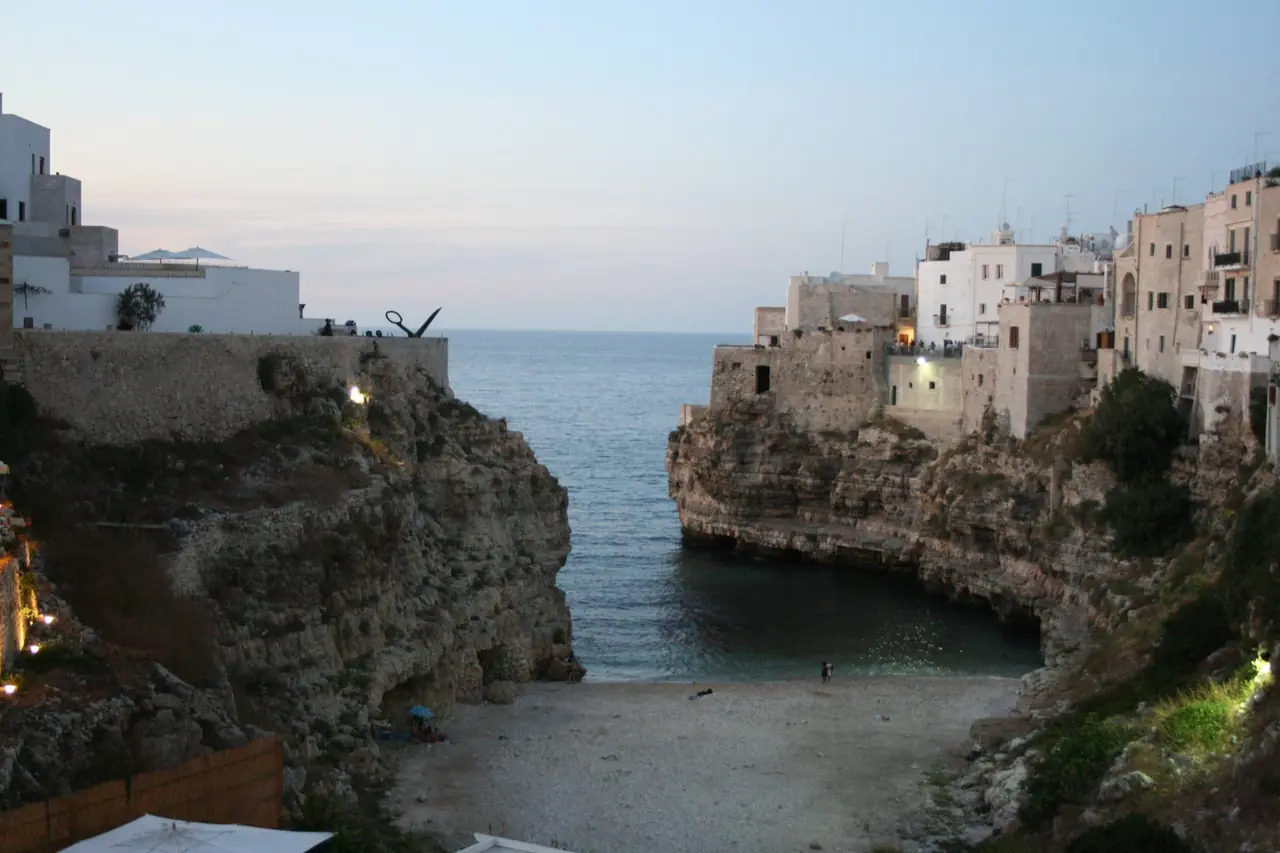
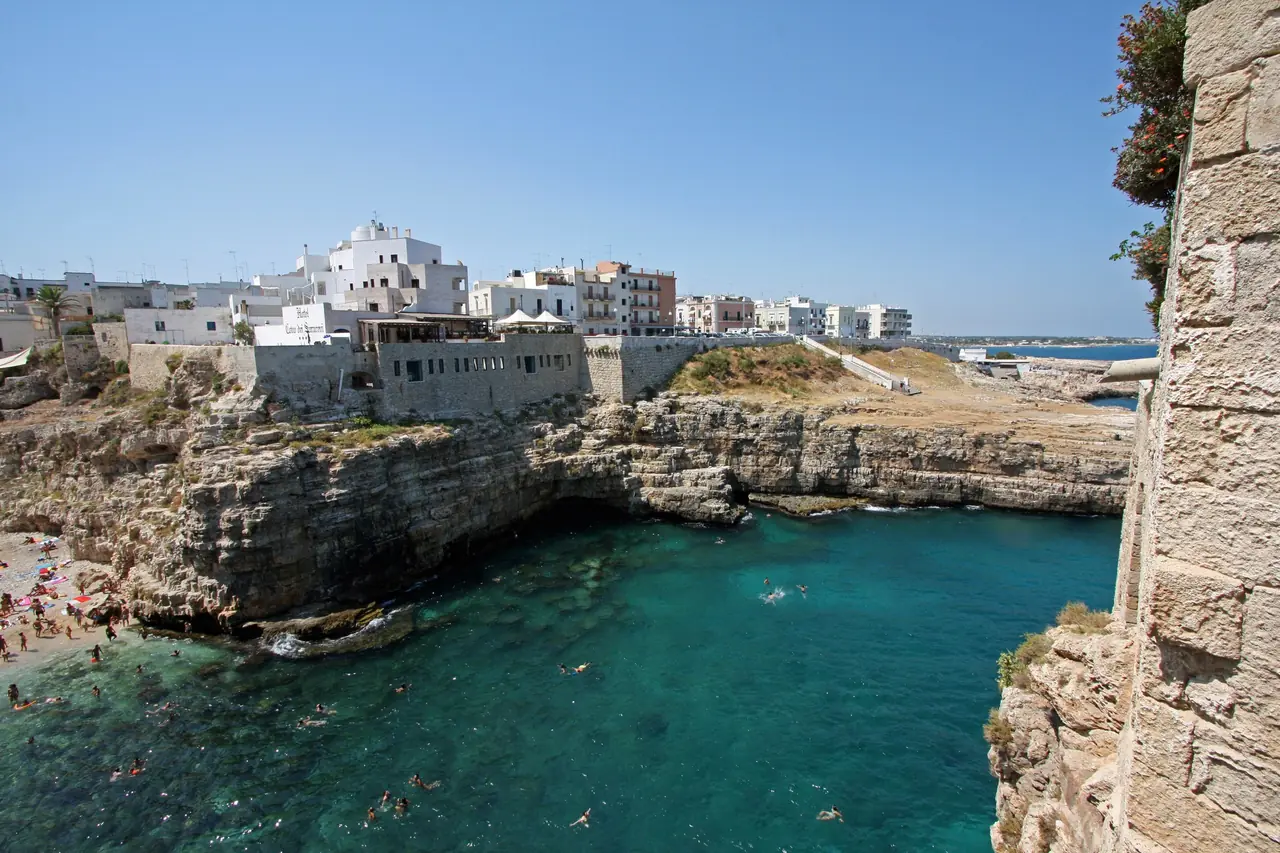
Lama Monachile is Polignano a Mare's best-known cove, a narrow limestone inlet with the old town rising directly above it. As a swimming spot it's covered in detail — along with the town's other beaches and sea caves — in our beaches of Polignano a Mare guide. Here, it's worth covering as a viewpoint: the bridge that spans the inlet is one of the fixed reference points of any visit, whether or not you go down to the water.
The bridge visible today, the Ponte Borbonico, was built in the early 19th century under Bourbon rule, ordered by Ferdinand I of the Two Sicilies as part of a new road connecting Bari and Lecce. It stands 15 metres (49 ft) above the cove, according to Italy's official tourism board, and steps lead down from it to the beach below. Local histories also place an earlier, Roman-era crossing on the same site, part of the Via Traiana route linking Benevento and Brindisi — a detail reported by local press but not confirmed by the tourism board's own page, so treat it as tradition rather than a settled fact.
Practical
Free and accessible at all times; no ticket needed to walk across or view it from either side. Getting there: Central, on the seaward edge of the old town — the bridge is the natural point where most walking routes through the centre end up. Practical note: The viewpoint from the bridge itself gets crowded around midday in summer; the Belvedere Santo Stefano, covered below, gives a similar outlook with fewer people.
Grotta Palazzese: a restaurant inside a sea cave
What it is
A restaurant terrace built inside a natural sea cave on Via Narciso, part of the Grotta Palazzese hotel.
Why it's worth it
The cave has been used for hosting meals since the early 18th century, when the local marquis, Leto, held banquets here; a watercolour by Jean Louis Desprez from 1783 documents the space in that period. It's a rare case of a natural cave still functioning as its original use, rather than as a preserved ruin.
Practical
Reservation-only, with pricing on request from the restaurant's official site — we haven't published a figure here because it changes by season and menu, and an outdated number is worse than none.
Getting there
On Via Narciso, on the clifftop edge of the old town, a short walk from Lama Monachile.
Practical note
You don't need to eat here to see the cave — it's visible, and photographable, from several public viewpoints along Via Narciso and the Belvedere Santo Stefano without a reservation.
Belvedere Santo Stefano
What it is
A public clifftop terrace on the site of the old Bastion of St Stephen, part of the town's historic coastal defences.
Why it's worth it
It looks back over Lama Monachile and the old town from a different angle than the bridge itself, away from the beach and its crowds.
Practical
Free, open-air, accessible at any time — there's no ticket or gate.
Getting there
A short walk from the historic centre, along the clifftop path that also passes Via Narciso and Viale Domenico Modugno.
Practical note
Facing roughly north, it catches good light in the morning; the bridge viewpoint faces the opposite way and suits late afternoon better.
The Domenico Modugno statue
What it is
A bronze statue, around 3 metres (10 ft) tall, of the singer-songwriter Domenico Modugno, arms wide open, standing on the seafront at Via Conversano 4 and turned towards the town rather than out to sea — the pose is described by Regione Puglia as an embrace of his home town.
Why it's worth it
Modugno was born in Polignano a Mare on 9 January 1928. His 1958 song "Nel blu dipinto di blu," known internationally as "Volare," won that year's Sanremo Music Festival and reached number one in the United States. It also took Record of the Year and Song of the Year at the first Grammy Awards in 1959 and remains, according to the Recording Academy, the only foreign-language recording ever to win either award. The open-armed pose echoes the song, whose title means "to fly."
Practical
Free, public, accessible 24 hours a day. The statue was unveiled on 31 May 2009, the work of the Argentine sculptor Hermann Mejer, per Regione Puglia's own entry on it.
Getting there
On the seafront at Via Conversano 4, along the promenade named after Modugno, a short walk from Lama Monachile and the Belvedere Santo Stefano.
Museo Pino Pascali
What it is
A contemporary art museum at Via Parco del Lauro 119, run by the Fondazione Pino Pascali, dedicated to the sculptor and artist Pino Pascali.
Why it's worth it
Pascali was born in Bari in 1935 to a family from Polignano a Mare and died in Rome in 1968, aged 33; he's buried in the town's cemetery. The foundation was established in 1998 after his family donated a body of his work and personal material, and it now runs contemporary exhibitions and the annual Premio Pino Pascali art prize alongside the permanent collection.
Practical
Open Wednesday to Sunday, 10:00-13:00 and 16:00-20:00, with last admission at 12:30 and 19:30; €10 full price, €6 reduced (over-65s and Polignano a Mare residents), free on the first Sunday of each month — as published on the foundation's official site, checked 19 August 2026. Opening hours change seasonally — check the official site before you go.
Getting there
Away from the clifftop cluster of sights, a 15-20 minute walk from the historic centre, or a short ride if you've got a bike with you.
Seeing Polignano a Mare by bike
See the coast at your own pace — book a bike in Polignano.
The most useful ride from Polignano a Mare follows the coast south to Monopoli: 9.2 km (5.7 miles) one way, with 28 m (92 ft) of climbing, according to route-planning data from Bikemap — we haven't ridden and logged this stretch ourselves, so treat the figures as planning distances rather than a track we've verified underfoot. About two-thirds of the route runs on paved asphalt, split between ordinary roads (roughly 63% of the distance) and a dedicated cycleway (around 19%), with the rest on quieter side roads. That road-heavy split means this isn't a fully traffic-free ride — expect some vehicle traffic on the shared sections, particularly closer to both towns.
The route is flat enough for most riders, including on a standard road or gravel bike, and takes around 30-40 minutes each way at an easy pace. There's little between the two towns, so fill your water bottle before setting off, either in Polignano's old town or in Monopoli once you arrive — the same applies on the way back. This stretch has since been plotted using OpenStreetMap-based routing, not a track ridden and logged by us: 8.6 km (5.3 miles) one way, with around 21 m (69 ft) of climbing.
For a bike delivered to your accommodation in Polignano a Mare, or picked up nearby, check bike availability through our Puglia rental hub — a road bike handles this route fine; if you're planning to continue further along the coast or inland toward Valle d'Itria, a gravel bike gives more flexibility. For the wider regional picture of where else you can ride from here, see our cycling in Puglia hub.
Getting to Polignano a Mare
Polignano a Mare sits on the Adriatic coast, on the regional train line that also serves Bari and Monopoli.
| From | Distance | By train | By road |
|---|---|---|---|
| Bari | 35 km (22 miles) | around 25 minutes, direct | around 40 minutes by car |
| Monopoli | 13 km (8 miles) by road | 5 minutes, direct | around 15 minutes by car |
| Lecce (our base) | around 117 km (73 miles) | around 1h20, direct on some services; others need a change at Bari | around 1 hour 30 by car |
Bari has the region's main airport and train hub, which makes it the easiest way in if you're arriving from outside Puglia — see our things to do in Bari guide if you're combining the two. For the wider context of where Polignano a Mare fits among Puglia's coastal towns, see our best places to visit in Puglia guide.
FAQ
What is Polignano a Mare famous for? Lama Monachile, the cove crossed by the Ponte Borbonico, the Grotta Palazzese cave restaurant, and being the birthplace of the singer Domenico Modugno, who wrote "Volare." Its clifftop old town is the setting for all of them.
How long do you need in Polignano a Mare? Half a day covers the historic centre and the two viewpoints. Add a couple of hours for the Museo Pino Pascali, which sits away from the clifftop cluster, if you want the full day.
Can you visit Polignano a Mare without a car? Yes. It's on the regional train line, around 25 minutes from Bari and 5 minutes from Monopoli, both with frequent services. Direct regional trains also run from Lecce in about 1 hour 20, though many services on that route need a change at Bari — check which one you're booking on Trenitalia before you travel.
Is the historic centre accessible with a pushchair or wheelchair? Parts of it aren't easy. The old town has narrow lanes, some with steps, and the clifftop setting means uneven ground in places, particularly around the viewpoints near Lama Monachile.
When do the boat tours of the sea caves run? Seasonally, roughly spring to autumn, but exact days depend on the operator and the weather — check current availability before you book.
What's the best time of year to visit? April-June and September-October give the mildest weather and the fewest crowds. July-August is hot and busy, especially around Lama Monachile and the old town's viewpoints.
See the coast at your own pace — book a bike in Polignano. We're based in Lecce, and Polignano a Mare sits outside our free-delivery area (Lecce, San Foca and Calimera) — but we still deliver here, quoted when you tell us your accommodation and dates.