
What to See and Do in Otranto: Cathedral, Castle and Coast
By Eugenio TommasiUpdated 19 August 2026 10 min read
Key facts
- Best for
- A walled Adriatic old town, a Norman cathedral mosaic, and Italy's easternmost point
- Time needed
- Half a day for the old town, cathedral and castle; a full day with the Colle della Minerva, the lighthouse or a beach
- Getting around
- On foot inside the old town; bike or car for the coast road, the lighthouse and Baia dei Turchi
- Indicative cost
- Cathedral entry is free for independent visits, €2 per person for guided groups (Arcidiocesi di Otranto, from 1 March 2026); Castello Aragonese from €3 (no exhibition) up to €12 (exhibition, high season), per the Comune di Otranto (verified 19 August 2026)
- Distance from Lecce
- 47 km (29 miles), about 45 minutes by car, or a flat 2-hour ride by bike at a relaxed pace
- Distance from Brindisi Airport
- 90 km (56 miles) by road, about 1 hour 20 minutes by car (verified 19 August 2026)
- When to go
- April-June and September-October for mild weather and quieter streets; swimming season runs roughly June-September
Otranto's old town: what to see first
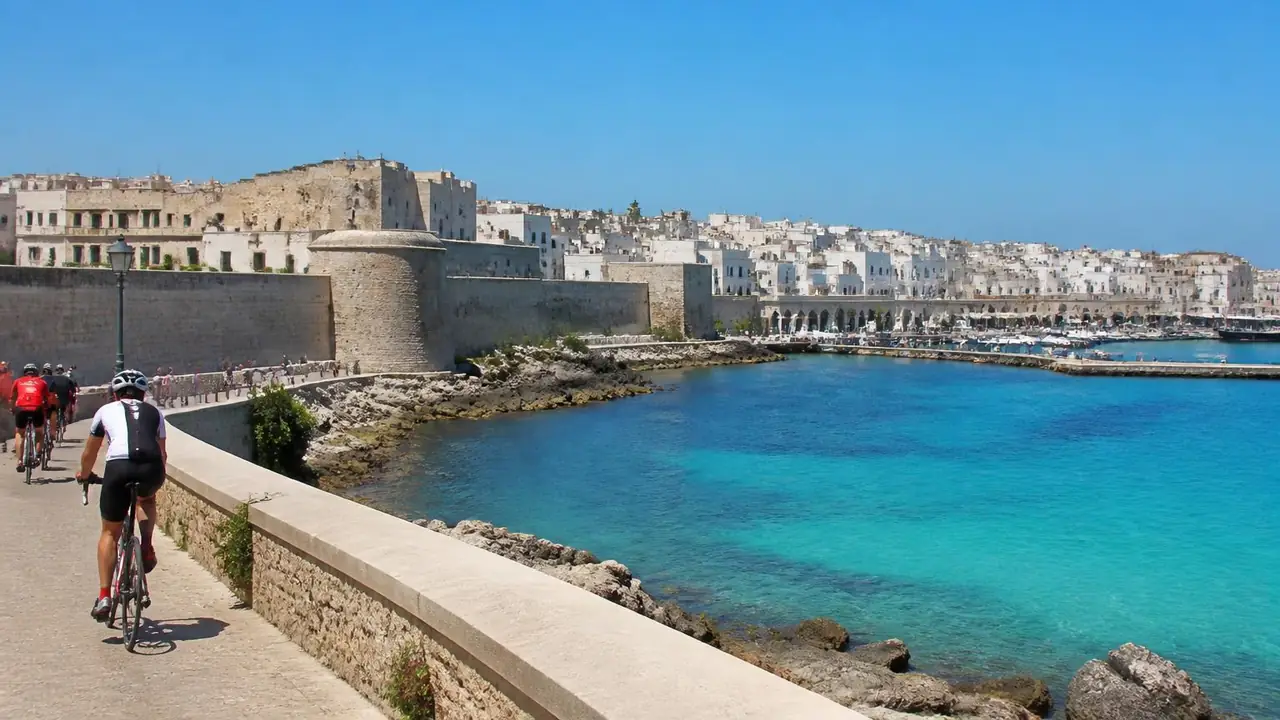
Otranto sits on Salento's Adriatic coast, its old town still enclosed by the medieval walls built after the city was sacked in 1480. The main entrance is Porta Alfonsina, raised by Alfonso of Aragon after that siege; from there, narrow streets of white and pale stone lead down to the harbour, with the Castello Aragonese guarding the water's edge and the Cattedrale di Otranto at the centre of the grid of lanes behind it. The Lungomare degli Eroi promenade runs along the seafront between the walls and the harbour, and it's where most of the town's bars and restaurants sit.
Otranto is one of the few places on this stretch of coast where the old town, the harbour and a swimmable stretch of sea (the small Spiaggia del Molo, right next to the historic centre) all sit within a few minutes' walk of each other. The old town itself is flat and easy on foot; everything below sits inside or just beyond the walls. Otranto is 47 km (29 miles) from Lecce by road, flat the whole way — see Seeing Otranto by bike below for how that ride, and the coast further south, actually work.
Riding this route on one of our bikes? Start from our bike rental in Otranto — delivery, sizes and prices are all there.
The historic centre, sight by sight
Cattedrale di Otranto (Santa Maria Annunziata)
What it is
the town's cathedral, founded in the 11th century, at the heart of the old town's street grid.
Why it's worth it
the reason to come is the floor. Laid between 1163 and 1165 by the priest Pantaleone, the mosaic runs 52 m through the nave in a single continuous "Tree of Life" made from more than 600,000 tesserae — the only complete Norman-era mosaic floor still preserved in Italy, according to mosaicodiotranto.com, the project dedicated to its conservation. It survived the 1480 Ottoman siege that destroyed the church's frescoes. At the end of the right nave, the Cappella dei Martiri holds the relics of the roughly 800 residents killed on the nearby Colle della Minerva after that siege, in seven reliquary cases — they were canonised as saints by Pope Francis on 12 May 2013, according to the official record of the canonisation Mass.
Practical
the Arcidiocesi di Otranto publishes opening hours of 08:30-12:00 and 15:30-18:30 (verified 19 August 2026). Independent visits are free; since 1 March 2026 the diocese charges €2 per person for groups visiting with a guide, teacher or escort, and groups of eight or more must book through mosaicodiotranto.com. The Museo Diocesano and the Chiesa di San Pietro cost €3 each, with combined tickets at €5 (cathedral, museum and church) or €4 (cathedral and church), per the diocesan notice on access. Opening hours change seasonally — check the official site before you go.
Getting there
on foot, in the middle of the old town — a few minutes from Porta Alfonsina. No bike or car access inside the pedestrian centre.
- First-hand tip: the mosaic reads better with a little planning — the "Tree of Life" trunk runs down the centre of the nave from the door to the altar, so a slow walk up the aisle follows the story roughly as it was laid out, rather than a single glance from the doorway.
Castello Aragonese
What it is
a 15th-century fortress at the edge of the old town, on Piazza Alcide De Gasperi, built and reinforced after the 1480 siege to defend the harbour.
Why it's worth it
it's the clearest physical reminder of why Otranto looks the way it does — a working defensive structure, moat included, rather than a decorative ruin, right where the town meets the sea.
Practical
per the Comune di Otranto (verified 19 August 2026), entry is €3 for the castle plus €3 for underground access when there is no exhibition on; during exhibitions the full ticket is €6 in low season and €12 in high season, with reduced rates for groups of 12 or more and Otranto Card holders, €7 for under-18s and residents in high season, and free entry for under-6s, licensed guides and disabled visitors with a companion. The two official sources differ on hours: the Comune's own listing gives 09:00-12:00 and 15:00-18:00 daily, while the Regione Puglia tourism portal visit.puglia.it lists 10:00 to midnight daily in high season. Opening hours change seasonally — check the official site before you go.
Getting there
on foot, at the edge of the old town by the harbour — a short walk from the cathedral.
- First-hand tip: check what's on before you go — the castle's programme shifts between quiet, low-cost visits and higher-priced exhibition periods, and the two experiences are quite different.
Chiesa di Santa Maria dei Martiri, Colle della Minerva
What it is
a small church on the Colle della Minerva, a low hill just south of the old town, rebuilt in 1614 on the site of an earlier chapel commissioned by Alfonso of Aragon.
Why it's worth it
this is where the roughly 800 residents who refused to convert were killed after the 1480 siege, led by Antonio Primaldo — the event behind the relics kept in the cathedral's Cappella dei Martiri, described above. It's a quieter, more direct way to stand at the actual site than reading the story in the cathedral alone.
Practical
reached via a long flight of steps. The Regione Puglia cultural heritage record for the church gives its address on the SP87 but publishes no visiting hours, and we found no hours on a diocesan or municipal source either — hours and prices can change, so confirm before you visit.
Getting there
on foot, about 800 m from Porta Alfonsina along the coast road toward Santa Cesarea Terme — roughly 10 minutes walking, a couple of minutes by bike.
- First-hand tip: it's easy to miss because it sits just outside the walls, on a road most visitors only drive past on the way south — worth the short detour if the history above matters to your visit.
Lungomare degli Eroi and Spiaggia del Molo
What it is
the seafront promenade running along the harbour side of the old town, with the small Spiaggia del Molo beach set into the walls near its northern end.
Why it's worth it
it's the town's main gathering point in the evening, and the only swimmable spot you can reach on foot directly from inside the historic centre, without a bike or a car.
Practical
free and open at any time; the beach gets busy from mid-morning in July and August.
Getting there
on foot, running along the outside of the old town walls between Porta Alfonsina and the harbour.
- First-hand tip: for more space and fewer people, the bigger sand beaches are outside town — see Baia dei Turchi below.
Beyond the walls: the lighthouse, the beaches and the coast
Faro di Punta Palascia
What it is
an active lighthouse on the Capo d'Otranto headland, built in 1867, a 32 m stone tower with a small sea museum attached, marking the easternmost point of the Italian mainland and the narrowest stretch of the Strait of Otranto.
Why it's worth it
on a clear day the Albanian coast is visible across the strait, and this is one of the few points in Italy where the sun rises first each morning. It's a genuine geographic landmark, not a viewpoint dressed up as one.
Practical
the tower and museum are not open to climb without prior arrangement. The Comune di Otranto's page on lighthouse opening times has stood empty since 2009, and we found no current visiting programme on any official source — hours and prices can change, so confirm before you visit. The headland itself and the approach path are publicly accessible.
Getting there
6.7 km (4.2 miles) south of Otranto by road, along the coast road toward Santa Maria di Leuca (part of the route described below), verified 19 August 2026 by OSRM routing on OpenStreetMap data; the last stretch to the lighthouse itself is on foot along a rock-cut path from the nearest parking area, near a military barracks.
- First-hand tip: this is the same coast road our guided Litoranea tour uses (see below) — riders doing that route pass within a short walk of the lighthouse without a detour.
Baia dei Turchi
What it is
a sand and pine-backed bay about 6 km (3.7 miles) north of Otranto along the Adriatic coast, according to the Regione Puglia tourism portal visit.puglia.it, inside the Parco Naturale Regionale Costa Otranto - Santa Maria di Leuca e Bosco di Tricase.
Why it's worth it
it's one of the larger sandy beaches on this stretch of coast, backed by pine woods rather than built-up seafront — a different setting from the compact town beach at Spiaggia del Molo.
Practical
the beach itself is free to reach on foot. You cannot drive to the sand: parking areas sit back from the shore and cost money in summer, followed by a 10-15 minute walk through the pine woods, per visit.puglia.it. Otranto's Ordinanza Sindacale 11/2025 (22 July 2025) bans driving and parking on unpaved roads inside wooded areas, with fines from €1,032.91 to €10,329.14, per the Comune di Otranto. Some stretches of the beach have paid beach-club concessions; check current pricing when you book, as we haven't found an official rate list to confirm it in advance.
Getting there
by bike or car, north along the coast road out of Otranto — about 9 km (5.6 miles) by road to the nearest parking area, verified 19 August 2026 by OSRM routing on OpenStreetMap data, then the walk through the pines. Flat the whole way, and a realistic ride rather than a drive-only destination.
- First-hand tip: it gets busy quickly once the summer car parks fill — arriving by bike means you're not searching for parking in August.
Otranto also sits within reach of the rest of Salento's coast: Gallipoli is on the Ionian side, and Santa Maria di Leuca, at the peninsula's southern tip, is reachable along the same coast road covered in the next section.
Seeing Otranto by bike
Otranto works two ways for cyclists: as the destination of a flat ride out from Lecce, and as the starting point of the harder coast road heading south.
Getting here: Lecce to Otranto is 47 km (29 miles), flat for the entire distance, around 2 hours at a relaxed pace on a road or gravel bike — the same route and distance we quote on our Lecce rental page.
Riding on from Otranto — the Litoranea to Santa Maria di Leuca: this is a route we already run as a guided full-day tour, not a distance we're estimating from a map. From Otranto, the coast road south runs 52.6 km (32.7 miles) to Santa Maria di Leuca, with 430 m of climbing — a continuous run of gentle rises and drops rather than one long hill, cresting at around 125 m near Torre Nasparo. The surface is asphalt throughout, on the SP358 provincial road (the last 8 km on the SP87), passing close to the Faro di Punta Palascia and through Santa Cesarea Terme. Distance and elevation data are from bici.style; this stretch is also the subject of an active roadworks project by the Provincia di Lecce to add dedicated cycle-path sections, so signage and short diversions can change while works continue.
Fill water bottles in Otranto's old town before setting off — the coast road south has long gaps between towns until Santa Cesarea Terme. Riding the full Litoranea in a day suits a confident rider rather than a first outing: 52.6 km with 430 m of climbing is a real effort in summer heat, and an e-bike takes the edge off it.
We run this as a full-day guided tour — small groups, 4-8 riders — through bike tours in Salento & Lecce, or rent the bike separately through bike rental in Lecce & Salento and ride it self-guided. For the wider picture of where else you can ride in the region, see cycling in Puglia.
How much time do you need in Otranto?
| Time available | What you can realistically cover |
|---|---|
| 2-3 hours | The old town on foot: Porta Alfonsina, the cathedral and its mosaic, the Lungomare degli Eroi |
| Half a day | The above, plus the Castello Aragonese and the Chiesa di Santa Maria dei Martiri on the Colle della Minerva |
| Full day | Old town and castle, plus a ride or drive to the Faro di Punta Palascia and Baia dei Turchi, or the start of the Litoranea south |
Otranto pairs naturally with the rest of the Salento coast on a longer trip — see our Salento travel guide for how it fits alongside Lecce, Gallipoli and Santa Maria di Leuca, and the best places to visit in Puglia for how Salento compares with the rest of the region.
Getting to Otranto without a car
Otranto has its own station, the terminus of the Ferrovie del Sud Est Maglie-Otranto branch (FSE line 7), so trains from Lecce involve a change at Maglie. In summer, Trenitalia also sells Otranto Link, a combined train-plus-coach ticket: you take the train to Lecce, then an FSE coach from Via Don Bosco near Lecce station down the coast to San Foca, Roca, Torre dell'Orso, Sant'Andrea, Laghi Alimini, Torre Santo Stefano and Otranto, with the coach leg priced at €3.40 one way, per Trenitalia (verified 19 August 2026). Check current timetables on the official FS Sud Est site before travelling, since regional schedules change seasonally and connections aren't always direct.
By road, Otranto is 47 km (29 miles) from Lecce and 90 km (56 miles) from Brindisi Airport — about 1 hour 20 minutes by car, verified 19 August 2026 by OSRM routing on OpenStreetMap data and cross-checked on a second routing server. Allow more in July and August. If you're arriving by bike from Lecce instead, see Seeing Otranto by bike above.
FAQ
What is the best time of year to visit Otranto? April-June and September-October give mild weather and quieter streets. July-August is busy and hot, with the old town and beaches at their fullest; swimming season runs roughly June to September.
Is Otranto's old town suitable for wheelchairs or pushchairs? The old town itself is flat, unlike hill towns further inland, though streets are narrow and some are cobbled. We haven't verified step-free access at specific sites such as the cathedral or castle, so it's worth checking directly with the venue if that matters for your visit.
Can I visit Otranto without a car? Yes — Otranto has its own station, the terminus of the Ferrovie del Sud Est Maglie-Otranto branch, reached from Lecce with a change at Maglie. In summer Trenitalia also sells Otranto Link, a combined train-plus-coach ticket from Lecce station down the coast to Otranto (€3.40 for the coach leg). Once there, the old town, harbour and Spiaggia del Molo are all within walking distance of each other.
Is there parking near Otranto's old town? The historic centre is largely pedestrian, so cars park around its edges near the walls. We haven't verified current paid or free parking zones from an official source, so check local signage on arrival.
Is Otranto suitable for a family visit with children? The old town is flat and compact, and the Spiaggia del Molo beach sits inside walking distance of the centre, which makes a family day manageable without much driving. Baia dei Turchi, a few kilometres north, is a better choice for a full beach day with more space.
How does Otranto compare to Lecce or Gallipoli? Otranto is a small walled port town built around a Norman cathedral and a 15th-century castle; Lecce, our home base, is a larger Baroque city inland; Gallipoli is a similarly compact old town on Salento's Ionian coast. See our Salento travel guide for how the three fit into one trip.
Ride the Otranto coast road. Rent a road, gravel or e-bike from our base in Lecce, 47 km away, and ride out to Otranto on flat roads — or tell us your dates and we'll quote delivery to Otranto directly. For the coast road south toward Santa Maria di Leuca, join our guided Litoranea tour instead of riding it solo.