What to Eat in Bari Vecchia, Bari's Old Town
By Eugenio TommasiUpdated 19 August 2026 6 min read
Key facts
- Best for
- A morning or early afternoon of street food and market browsing in Bari Vecchia, combined with a look at the old town's main sights
- Time needed
- 2-3 hours to cover the food side of Bari Vecchia properly; the pasta-makers of Strada Arco Basso are usually out from mid-morning
- Getting around
- On foot only — Bari Vecchia's alleys are narrow, several don't allow bikes or cars, and everything in this guide is within a 10-15 minute walk
- Cost
- Street food here (a panzerotto, a slice of focaccia, a portion of sgagliozze) is priced per item at each stall or bakery — check current pricing when you order, since we haven't verified up-to-date prices for this guide
Best places to eat in Bari old town: what to look for
Bari Vecchia doesn't have a single "best restaurant" that outranks the rest — its food reputation is built on street-level traditions rather than one address, which is also why we're not naming a trattoria here without having eaten there ourselves. What's worth planning around is four things: watching orecchiette get rolled by hand on Strada Arco Basso, a fried snack from a friggitoria (panzerotti or sgagliozze), a slice of focaccia barese from a bakery, and a walk through Piazza Mercantile and the old port.
Some of this is ready to eat on the spot; some isn't. The table below is a quick reference before the detail in each section.
| Food | What it is | Ready to eat now, or take away? |
|---|---|---|
| Orecchiette (Strada Arco Basso) | Fresh, hand-rolled ear-shaped pasta, sold raw by weight | Take away — it needs cooking |
| Panzerotti | Fried or baked dough pocket, usually tomato and mozzarella | Ready to eat, hot from the fryer |
| Sgagliozze | Fried polenta, cut into slices and salted | Ready to eat, hot from the fryer |
| Focaccia barese | Olive-oil-soaked focaccia with potato worked into the dough | Ready to eat, sold by the slice |
Riding this route on one of our bikes? Start from our rent a bike in Puglia — delivery, sizes and prices are all there.
The orecchiette makers of Strada Arco Basso
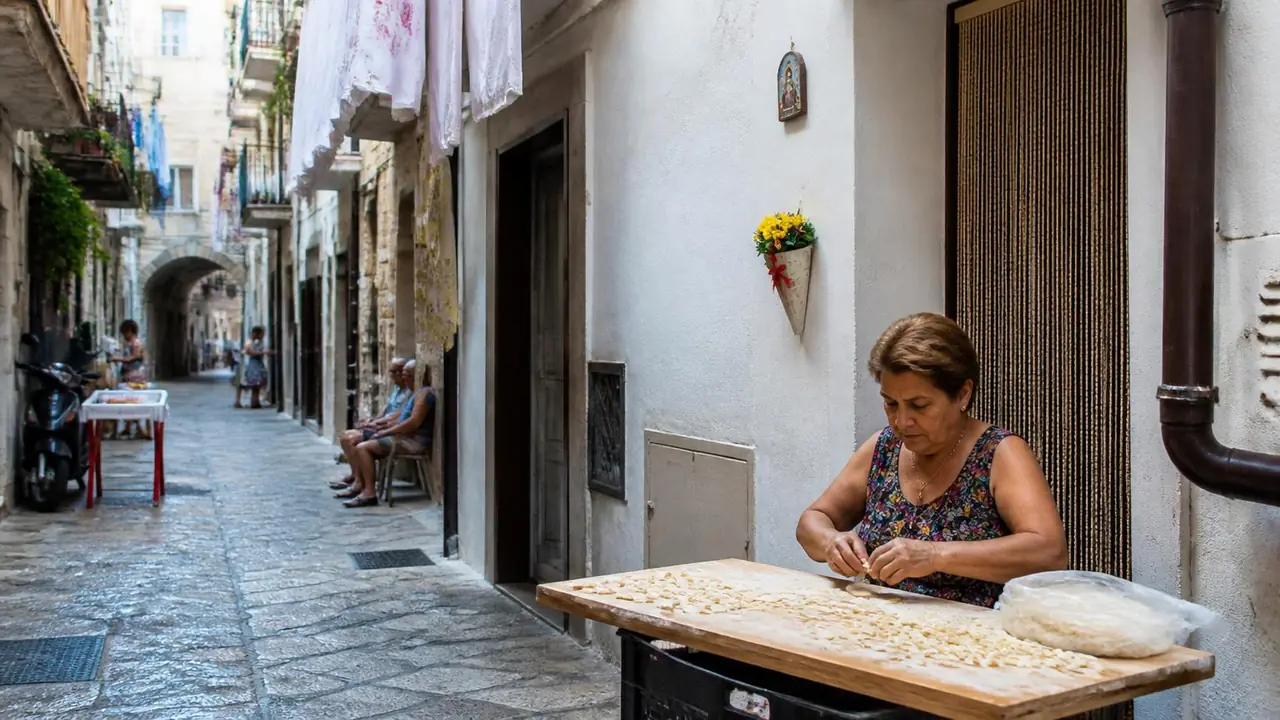
Strada Arco Basso, sometimes called the Strada delle Orecchiette, is the best-known food stop in Bari Vecchia. From mid-morning, women set up small tables outside their own doorways and hand-roll orecchiette — the small, ear-shaped pasta the region is known for — in full view of anyone walking past.
According to italia.it, the official Italian tourism portal, Bari Vecchia's street layout dates to the Byzantine period, and this stretch of alley has kept its working character rather than becoming a backdrop staged for visitors. The pasta itself is sold raw, by weight, for that day — it isn't packaged as a souvenir.
Buying a portion is welcome; photographing without buying anything, less so, on a street where this is someone's actual livelihood rather than a display. Prices are set per stall and change, so we're not quoting a figure here — check current pricing when you buy.
Since the orecchiette is raw, you can't eat it standing there — it needs boiling, so it's a take-home or take-to-a-restaurant purchase rather than a snack. Several trattorias in the surrounding alleys serve it cooked, typically con le cime di rapa (with turnip tops), the dish orecchiette is most often paired with in Bari. We haven't eaten at a specific one ourselves, so we're not recommending an address.
Panzerotti, sgagliozze and Bari Vecchia's friggitorie
A friggitoria (fry shop) is the other classic stop in Bari Vecchia, and the two things to order are panzerotti and sgagliozze.
A panzerotto is a half-moon pocket of pizza dough, usually filled with tomato and mozzarella, then fried until the outside is crisp and the inside is molten. It's widely reported as originating in Puglia, with Bari and Taranto usually credited as the towns where the tradition has stayed strongest, and Bari Vecchia specifically named as a place where it's still made following the original recipe rather than assembled from a freezer.
Sgagliozze are simpler: polenta, dried for a few days to firm up, cut into slices — square or rectangular in the Bari version, rather than the triangular cut used further north in Foggia — and fried in hot oil, then salted. They're a fry-shop order rather than a sit-down dish, meant to be eaten hot, straight from the paper.
Both are priced per piece or by weight at the counter, and neither needs a reservation or a wait beyond however busy the fryer is. We haven't confirmed current prices for either across Bari Vecchia's friggitorie for this guide, and we're not naming a specific shop, for the same reason as the orecchiette stalls above — we'd rather say that honestly than invent a favourite we haven't tried — check current pricing when you order.
Focaccia barese and bread
Focaccia barese is thicker and more oil-soaked than the version found further north in Italy, with a small amount of potato worked into the dough to keep it soft. Bakeries across Bari Vecchia sell it by the slice, usually topped simply with cherry tomatoes and oregano, sometimes with olives.
Puglia's other well-known bread, pane di Altamura, comes from Altamura, a town about 50 km inland from Bari by road. It received DOP (Protected Designation of Origin) status in July 2003, under Commission Regulation (EC) No 1291/2003 of 18 July 2003; the protected area covers Altamura, Gravina in Puglia, Poggiorsini, Spinazzola and Minervino Murge, and the bread must be made from local durum wheat semolina with sourdough, sea salt and water. It isn't a Bari Vecchia speciality as such, and we haven't confirmed how widely it's stocked in the old town's own bakeries, but it's worth asking for if you want to try Puglia's best-known bread while you're in the area — treat its availability in any one bakery as something to check on the day rather than a guarantee.
As with the other food in this guide, we're describing the type of bakery you'll find rather than naming one — a queue mid-morning is usually a reasonable sign to follow.
Piazza Mercantile, the old port and Bari Vecchia's markets
Piazza Mercantile and Piazza del Ferrarese sit at the point where Bari Vecchia meets the modern city and the old port, and they're the liveliest part of the old town from late afternoon onward, with bars and restaurants around both squares. For the history of the two piazzas, and the rest of the old town's landmarks — the Basilica di San Nicola, Cattedrale di San Sabino, Castello Svevo and Teatro Petruzzelli — see our full things to do in Bari guide; we're keeping this piece to the food side rather than repeating that detail here.
Fishing boats work out of the old port at Molo San Nicola, beside Piazza del Ferrarese, and the sale of fish there is regulated rather than informal. The Comune di Bari has set out the terms: small-scale fishermen may sell their own catch on the quay from a covered structure, provided they hold authorisation to occupy public maritime land, the fish is traceable and demonstrably caught by the seller, and it meets the health rules for seafood. Water from the harbour itself may not be used at any point — the city has stated plainly that "le acque putride dello specchio d'acqua del porto non potranno in nessun modo essere utilizzate", so vendors have to bring their own clean water supply.
The part visitors ask about — buying raw seafood to eat standing there — is where this gets more complicated, and it's worth being direct rather than romantic about it. The city's Polizia Locale has repeatedly seized raw shellfish and molluscs set out for on-the-spot tasting by tourists precisely because the seller could produce no traceability documentation — in one case around 5 kg of oysters, sea urchins, prawns, octopus and cuttlefish, laid out with lemons and plastic plates, returned to the sea and the vendor sanctioned and ordered off the quay under the Puglia regional commerce rules. That is the city's own account of it, not ours. We're not going to tell you to eat raw seafood on the quay, and we'd rather say that than repeat a picturesque version of the scene: if you do, buy only from a vendor who can show you where the catch came from.
If you're using Bari as a base for more than the old town, see our day trips from Bari guide, or our best places to visit in Puglia guide for how it fits into a wider trip.
Seeing Bari Vecchia by bike
Bari Vecchia itself isn't a place to cycle. The alleys are narrow, uneven in places, busy with pedestrians and mopeds, and several streets don't allow bikes at all — the same point made in our main Bari guide. If you're after a genuine ride through the old town's lanes, this isn't it, and we'd rather say that plainly than stretch the truth to make the food stops sound more bike-friendly than they are.
Where a bike does earn its place is getting to Bari Vecchia and back. The old town sits at the northern end of the Lungomare Nazario Sauro, Bari's seafront, which has had a marked cycle lane — painted lines rather than a physically separated track — on part of its length since 2022. From the Basilica di San Nicola, on the edge of Bari Vecchia, it's a flat 4 km (2.5 miles) south to Pane e Pomodoro, Bari's city beach, entirely on asphalt. If you're staying along the coast rather than in the old town itself, riding in this way and then walking the alleys is more realistic than finding parking for a car.
Once you're at the edge of Bari Vecchia, leave the bike and walk — we haven't confirmed where secure bike parking is available right at the old town's edge, so check with wherever you're staying or renting from before you go. For the wider picture of riding this stretch of coast, see our cycling in Puglia guide.
Riding this stretch of coast? Rent a road or gravel bike from our Puglia hub — either handles the lungomare's flat asphalt easily.
FAQ
Is Bari old town safe at night? The main routes around Piazza Mercantile and Piazza del Ferrarese are busy with bars and restaurants into the evening and reasonably well lit. Ordinary town-centre caution applies on the quieter side alleys, as in any dense old town — nothing specific to Bari Vecchia beyond that.
Can you eat orecchiette made in the street in Bari Vecchia? No — the orecchiette sold on Strada Arco Basso is fresh, raw pasta, bought by weight to cook, not a ready-to-eat snack. Several trattorias nearby serve it cooked, usually with turnip tops (cime di rapa), if you'd rather eat it straight away.
Is Bari Vecchia walkable? Yes. Bari Vecchia is compact and flat, and you can walk across it in about fifteen minutes, though the food stops in this guide are worth spreading over two to three hours. Several of its alleys don't allow bikes or cars at all.
What's the best time of day to visit Bari Vecchia for food? From mid-morning, when the orecchiette makers of Strada Arco Basso are usually out and bakeries have fresh focaccia. Late afternoon into the evening suits the friggitorie and the squares around Piazza Mercantile, which get busier as restaurants open for dinner.
Can vegetarians eat well in Bari Vecchia? Orecchiette con cime di rapa, focaccia barese and sgagliozze are all naturally vegetarian, and are three of the district's most common foods. Panzerotti are usually filled with tomato and mozzarella, also vegetarian, though it's worth checking with the specific stall if fillings vary.
Explore Puglia beyond Bari — rent a bike with delivery. We're based at Via Francesco Ribezzo 2D, Lecce — open 24/7, phone +39 320 4864478 — with free pickup at our shops in Lecce, San Foca and Calimera, or paid delivery to your accommodation. Bari sits well outside that free-delivery zone, but tell us your dates and we'll quote delivery there, or have a bike ready in Lecce if Bari Vecchia is one stop on a longer Puglia trip.